Overview
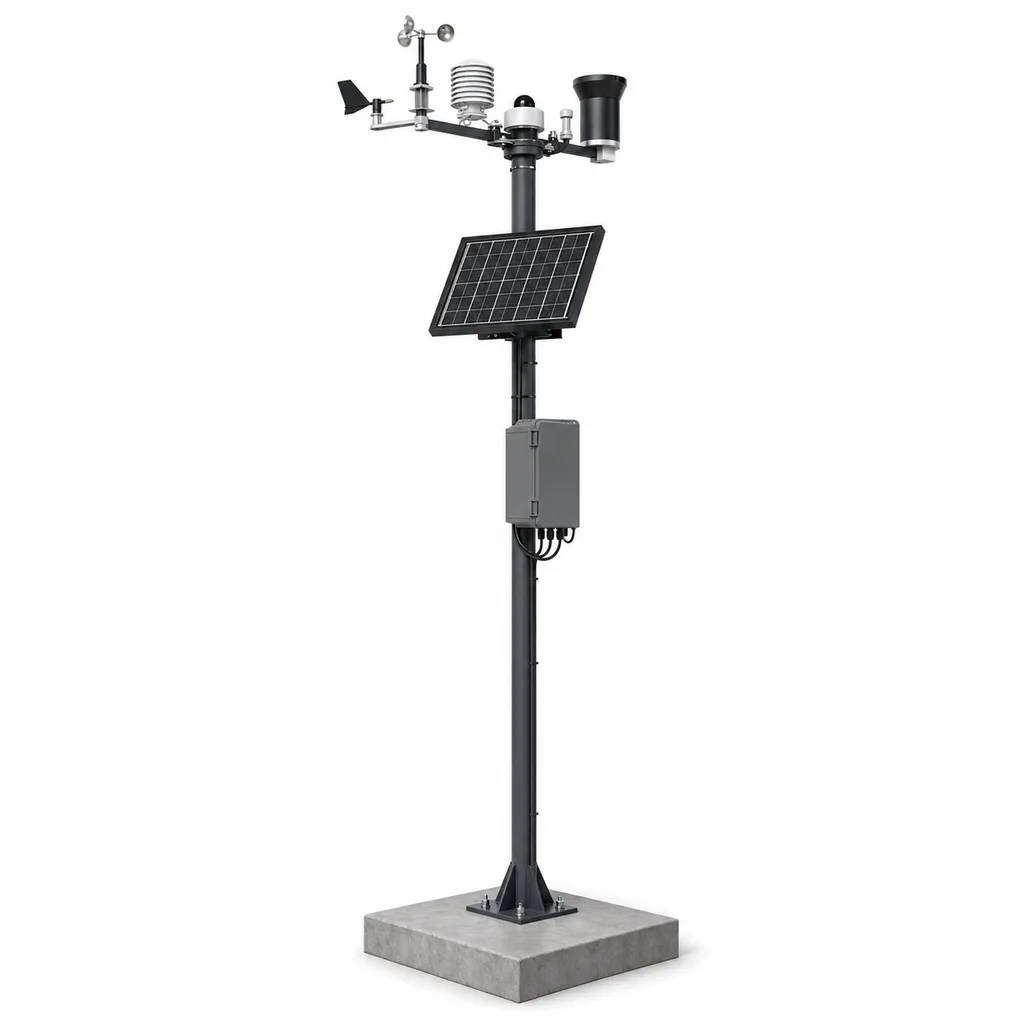
The Redcoast RC-AWS-200 is an off-grid solar-powered Automatic Weather Station (AWS) engineered for unmanned, year-round, WMO-class meteorological monitoring in any climate or grid environment. It serves precision agriculture, civil aviation support, road weather services (RWIS), smart-city ambient sensing, climate-research baselines, renewable-energy yield benchmarking, and remote industrial sites. Unlike repackaged kits sold by generic integrators, Redcoast designs the multi-sensor signal-conditioning PCB, the MPPT power-management board, the edge IoT gateway firmware, and the companion cloud agent in-house — so every project-specific request (an extra sensor channel, an in-country SCADA bridge, a regional satellite back-up, a custom mast geometry) can be solved at the board-and-firmware level instead of bolting workarounds onto a closed product.
Key Features
- WMO-compliant 6- to 10-parameter sensor suite covering wind speed, wind direction, air temperature, relative humidity, barometric pressure, precipitation, solar radiation, with optional UV index, soil moisture/temperature, leaf wetness, visibility, and road-surface temperature/ice channels
- Redcoast-designed Multi-Sensor Acquisition Board (MSAB) with 24-bit ADC channels, SDI-12, RS-485/Modbus, pulse-count, and isolated 4–20 mA inputs — per-channel galvanic isolation eliminates mast-induced ground loops
- Redcoast-designed MPPT-200 power board with up to 95 % conversion efficiency, LiFePO4 battery management, real-time SOC and panel-health telemetry exposed to the gateway
- Edge IoT gateway with ARM Cortex-A class SoC, 32 GB industrial flash, automatic WMO Guide 8 quality-control flagging, store-and-forward sync, OTA firmware updates
- Multi-network connectivity: dual-SIM 4G LTE Cat-1/Cat-M1, NB-IoT, LoRaWAN, optional Iridium SBD / Inmarsat BGAN satellite, plus Ethernet and Wi-Fi for local commissioning
- Hot-dip galvanised plus smooth powder-coated mast in 1.5 / 3 / 6 / 10 m heights, hinged tilt-down option for safe sensor servicing without climbing
- Open data formats and protocols: CSV, JSON, MQTT, MQTT-SN, Modbus TCP, FTP, REST — clean integration with Redcoast Cloud or any third-party SCADA / agronomy / aviation / smart-city platform
- IP66 enclosures, -40 °C to +70 °C operation, salt-fog/sand/UV-resistant materials, lightning protection per IEC 62305, wind survival to 60 m/s
Technical Architecture
At the heart of the RC-AWS-200 is the Redcoast Multi-Sensor Acquisition Board (MSAB), an in-house-designed PCB that aggregates analogue, digital, and serial sensor inputs and translates them into calibrated engineering units. The MSAB provides 8 differential 24-bit ADC channels for high-resolution thermistor, RTD, and bridge inputs; 4 SDI-12 ports for industry-standard meteorological transducers (soil probes, ultrasonic anemometers, road-surface sensors); 4 isolated RS-485/Modbus channels; 4 pulse-counting inputs for tipping-bucket rain gauges and cup anemometers; and 4 isolated 4–20 mA loops. Each channel is galvanically isolated to prevent ground loops between dissimilar sensors distributed along a tall mast. A precision voltage reference plus on-board temperature compensation keep long-term drift within 0.05 %/°C, supporting WMO Class A measurement performance with appropriately specified sensors.
Power is managed by the Redcoast MPPT-200, an in-house DC-DC converter and battery-management board that harvests up to 25 A of solar current at up to 95 % efficiency, balances LiFePO4 cells, monitors per-cell temperature, and disconnects the load on low voltage to protect the battery. The MPPT-200 communicates with the gateway over I²C, exposing real-time SOC, panel voltage and current, battery health, and cycle count for predictive maintenance — the AWS therefore reports its own health as another telemetry stream alongside the weather data, letting operators schedule site visits before failures happen rather than after.
The edge IoT gateway runs a Linux-based logger application that scans sensors at configurable intervals from 1 second to 60 minutes, applies WMO Guide 8 quality-control flags (range, persistence, step, internal-consistency tests), writes time-aligned records to 32 GB of industrial-grade flash, and forwards data over the most appropriate available link. When connectivity is restored after an outage, buffered records are replayed in correct chronological order, ensuring zero data loss. The gateway also runs the Redcoast cloud agent for secure TLS upstream and exposes a local web UI for installers and field technicians — no laptop application required.
Connectivity & Power
Connectivity is one of the AWS's defining choices and is matched to the application. Agricultural deployments typically favour NB-IoT or LoRaWAN for very low power draw and excellent rural penetration. Aviation, port, and road-weather sites usually prefer 4G LTE for low-latency reporting and the ability to back-haul auxiliary camera or visibility-sensor streams. Remote alpine, desert, marine, and polar sites switch to Iridium SBD or Inmarsat BGAN for guaranteed satellite reach where there is no terrestrial coverage. The gateway supports dual-SIM 4G with automatic fail-over to NB-IoT and then to satellite. Ethernet and Wi-Fi are present for on-site commissioning and for the minority of grid-connected installations.
Power is sized to the local climate, not sold as a one-size-fits-all bundle. A baseline configuration of one 150 W monocrystalline panel and a 100 Ah LiFePO4 pack covers most temperate-zone deployments with 10 days of no-sun autonomy. For high-latitude or persistently cloudy regions the system scales to dual 200 W panels and 200–400 Ah of LiFePO4. Optional small wind turbines and fuel-cell back-ups are available for polar-night or extended bad-weather operation. The MPPT-200 board supports panel voltages from 12 V to 96 V and battery banks from 12 V to 48 V, so the same controller is reused across very different power budgets — simplifying spares and training across a fleet.
Protection & Reliability
All electronics live in an IP66 powder-coated aluminium enclosure with stainless-steel hinges and EPDM gasketing. The MSAB and gateway boards are conformal-coated for high-humidity, salt-fog, and dust exposure. The mast itself is hot-dip galvanised internally for corrosion protection and finished with a smooth matte powder-coat (default RAL 7016 anthracite; white, sand, forest-green, or custom RAL available) for UV stability and aesthetic durability. The enclosure tolerates ambient temperatures from -40 °C to +70 °C, 0–100 % relative humidity (condensing), and meets IEC 60068-2 vibration and shock profiles for transport and seismic regions.
Wind survival is engineered to 60 m/s (216 km/h) with appropriate guying on the 10 m mast; cyclone-exposed coastal configurations add stainless guy wires and a heavier ballast base. Lightning protection is integrated rather than retrofitted: a Franklin air terminal at the mast top, an AWG 4 down-conductor, isolated chassis grounding via a buried earth electrode, and Type II surge-protection devices on every external cable entering the enclosure. Designed service life of the structural and power-electronics components exceeds 15 years; sensor service life is typically 8–10 years, with recommended calibration every 12–24 months.
Application Scenarios
- Smart agriculture and irrigation scheduling: continuous wind, temperature, humidity, solar-radiation and rainfall data feed reference evapotranspiration (ET0) calculations that drive precision-irrigation valves — saving water and improving yield in large farms, vineyards, orchards, and greenhouse-cluster sites.
- Airport and heliport meteorological awareness: small civil aerodromes, offshore helidecks, and private airstrips deploy the AWS for wind, gust, QNH, temperature, dewpoint and optional visibility to support METAR-style local reporting and pre-flight briefings without staffing a full meteorological office.
- Road Weather Information Systems (RWIS): highway authorities install the AWS at mountain passes, tunnel approaches, and major bridges to monitor cross-wind, freezing risk, and visibility, then integrate with Redcoast solar variable-message signs (VMS) for live driver warnings.
- Smart-city hyperlocal ambient sensing: city dashboards combine RC-AWS-200 data with air-quality and noise stations to publish neighbourhood-level weather to residents and to drive heatwave / cold-wave emergency-management plans.
- Hydrology and watershed climate baseline: paired with Redcoast solar flood and water-level stations, the AWS supplies the atmospheric variables (rainfall, evaporation drivers, wind) that hydrological models need to forecast runoff and flood risk.
- Renewables and solar-farm yield benchmarking: pyranometer, ambient temperature, wind, and humidity data benchmark expected versus actual generation, informing performance-ratio audits, warranty disputes, and curtailment decisions on solar and wind plants.
Case-style Examples
Case 1 — Vineyard irrigation network, temperate inland estate A 1,200-hectare vineyard estate needed a network of seven low-maintenance weather stations to feed an ET0-driven drip-irrigation scheduler. Each site was off-grid and several kilometres from the nearest power line. The estate chose RC-AWS-200 units with NB-IoT links and LoRaWAN as a back-up where cellular coverage was weak. After one growing season the data showed a 22 % reduction in irrigation water versus the prior calendar-based schedule, with no reduction in fruit quality. The on-board MPPT health telemetry allowed the maintenance team to pre-empt a single panel-cable failure caused by rodent damage before it took a station offline.
Case 2 — Mountain-pass road weather corridor A highway authority operating a 2,400 m high pass deployed three RC-AWS-200 stations along a 40 km alpine corridor, each linked to a Redcoast solar VMS sign downstream. The stations carried cross-wind anemometers, freezing-rain sensors, and forward-scatter visibility transmissometers. In the first winter the system triggered 47 automated VMS warnings for ice and cross-wind events, and the authority reported a 31 % reduction in weather-related incidents on the corridor compared with the previous season.
Case 3 — Remote solar-farm performance-ratio validation A 35 MW utility solar farm in an arid remote region required independent meteorological data for its performance-ratio reporting under an EPC warranty clause. A pair of RC-AWS-200 stations — one with a pyranometer plus reference cell, one with full meteorology — were installed on-site with a 4G primary link and Iridium SBD back-up for site-wide outage tolerance. The independent dataset settled a multi-million-dollar performance dispute with the EPC contractor and became the long-term reference dataset for the plant's O&M operator.
Customization & Selection Guide
Choosing an RC-AWS-200 configuration starts with the application profile. For agriculture, customers typically pick the AGRI package: cup anemometer at 2 m, thermo-hygro at 2 m and 0.5 m, tipping-bucket rain gauge, pyranometer, and an SDI-12 soil-moisture and soil-temperature probe at 10/20/40 cm. For aviation, the AVIA package raises the anemometer to 10 m and adds a precision barometer, dewpoint output, and optional visibility transmissometer. For road weather, the ROAD package adds a road-surface temperature sensor, an ice / water-film detector, and a forward-scatter visibility sensor. For climate research the CLIMATE-A package upgrades sensors to WMO Class A accuracy and adds redundant logging. For renewables the RE-PR package adds a reference solar cell, back-of-module temperature sensor, and dual pyranometers. Power is then chosen by latitude and cloud climate; connectivity by coverage; mast height (1.5 / 3 / 6 / 10 m) by sensor-exposure requirements. Redcoast's engineering team replies to every enquiry with a project-specific BOM and a wind/structural calculation for the chosen mast geometry and guying configuration.
Deployment & After-sales
The RC-AWS-200 ships as a pre-wired, factory-tested system: mast sections, foundation anchors, sensors with individual calibration certificates, a pre-mounted enclosure with batteries (shipped at IATA-compliant storage SOC), and a project-specific commissioning workbook. Typical installation is two technicians for one day on a prepared foundation. Commissioning is performed via the local web UI: zero-touch SIM provisioning, sensor verification, time synchronisation, and an auto-generated hand-off report. Redcoast offers operator training (on-site or remote), a standard 24-month hardware warranty extendable to 60 months, and a recommended spare-parts kit (gateway board, MPPT board, common sensors) for fleet operators. Lead times are usually 6–10 weeks depending on sensor sourcing and project complexity.
Standards & Compliance
Sensor selection and siting follow WMO Guide No. 8 (Guide to Instruments and Methods of Observation) and WMO-No. 488 where applicable. The mast and base structure conform to EN 1993-3-1 (steel structures — towers and masts) and IEC 61400-12-1 where wind-resource measurements are required. Electronics carry CE marking (EMC Directive, Low-Voltage Directive) and RoHS; FCC Part 15 (USA) and ISED (Canada) compliance is available on request. The enclosure is IP66 per IEC 60529. Lightning protection follows IEC 62305. The cellular module supports global LTE bands (Cat-1/Cat-M1/NB1/NB2) for worldwide deployment, with regional firmware variants where required by local regulators.
Why Redcoast
Most off-grid weather stations sold today are repackaged kits of third-party loggers, panels, and batteries — which means every project-specific request (an extra sensor channel, a different communications link, an unusual mast height, a localised data-protocol bridge, a paint colour that matches the municipal palette) becomes a re-engineering negotiation that delays delivery and inflates cost. Redcoast is different: we design the signal-conditioning PCB, the MPPT board, the gateway firmware, and the cloud agent ourselves. When a customer needs an additional SDI-12 channel, a custom Modbus register map for an in-country SCADA, a regional satellite back-up, or a specific RAL colour for visual integration with surrounding infrastructure, we make the change at the PCB-and-firmware level rather than bolting on add-ons. The result is a meteorological station that fits the project, not the other way around.
Contact Redcoast with your site profile, sensor priorities, and connectivity environment — we will return a tailored BOM, mast/structural calculation, drawings, and quotation within one working week.
Specifications
Meteorological Sensors
- Wind Speed Range
- 0-75 m/s
- Wind Direction Range
- 0-360 °
- Air Temperature Range
- -50 to +70 °C
- Relative Humidity Range
- 0-100 %RH
- Barometric Pressure Range
- 500-1100 hPa
- Solar Radiation Range
- 0-2000 W/m²
- Rainfall Resolution
- 0.2 mm/tip
- Optional Channels
- UV / Soil moisture & temp / Leaf wetness / Visibility / Road surface temp & ice
Data Logger & Edge Gateway
- Processor
- ARM Cortex-A class SoC, Linux
- Local Storage
- 32 GB industrial flash
- ADC Resolution
- 24 bit
- Sampling Interval
- 1 to 3600 s (configurable)
- Sensor Inputs
- 8 ADC + 4 SDI-12 + 4 RS-485/Modbus + 4 pulse + 4 isolated 4–20 mA channels
- Data Protocols
- CSV / JSON / MQTT / MQTT-SN / Modbus TCP / FTP / REST
- Quality Control
- WMO Guide 8 range / persistence / step / consistency flags
Power System
- Solar Panel
- 100-400 W (monocrystalline)
- Battery
- LiFePO4 100-400 Ah
- MPPT Conversion Efficiency
- up to 95 %
- Battery Autonomy (no sun)
- 7-15 days
- System Voltage
- 12 / 24 / 48 V DC
- Hybrid Options
- Small wind turbine / fuel-cell back-up
Communications
- Cellular
- Dual-SIM 4G LTE Cat-1 / Cat-M1 / NB1 / NB2 (global bands)
- LPWAN
- LoRaWAN 868/915 MHz
- Satellite (optional)
- Iridium SBD / Inmarsat BGAN
- Local Interfaces
- Ethernet 10/100, Wi-Fi 2.4 GHz
- Security
- TLS 1.3, X.509 device certificate, OTA signed firmware
Mast & Structure
- Mast Height Options
- 1.5 / 3 / 6 / 10 m
- Mast Material
- Hot-dip galvanised steel + powder-coat
- Surface Finish
- Smooth matte powder-coat (RAL 7016 default; white / custom RAL)
- Wind Survival
- up to 60 m/s
- Lightning Protection
- Franklin terminal + Type II SPDs per IEC 62305
- Servicing
- Hinged tilt-down option for sensor access
Environment & Reliability
- IP Rating (enclosure)
- IP66
- Operating Temperature
- -40 to +70 °C
- Humidity
- 0-100 (condensing) %RH
- Salt-Fog Resistance
- IEC 60068-2-52
- Vibration / Shock
- IEC 60068-2-6 / -27
- Design Service Life (structure/electronics)
- 15+ years
- Sensor Calibration Interval
- 12-24 months
Capabilities — configurable per project
Specifications are tailored to each project — the options below show what we can support.
Sensor Package
- AGRI (agriculture/ET0)
- AVIA (aviation/heliport)
- ROAD (RWIS)
- CLIMATE-A (Class A research)
- RE-PR (renewables performance ratio)
Power Configuration
- Solar 150 W / 100 Ah
- Solar 2x200 W / 200 Ah
- Solar 2x200 W / 400 Ah
- Solar + small wind hybrid
- Grid + battery back-up
Connectivity
- 4G LTE Cat-1/Cat-M1
- NB-IoT
- LoRaWAN
- Iridium / Inmarsat satellite
- Ethernet / Wi-Fi
Mast Configuration
- 1.5 m short post
- 3 m garden mast
- 6 m standard mast
- 10 m guyed mast
- Tilt-down hinged mast
Deployment Climate
- Coastal / marine (salt-fog)
- Desert / arid
- Tropical / high humidity
- Alpine / cold-climate
- Urban / smart-city
Related solution guidance

Environmental Monitoring
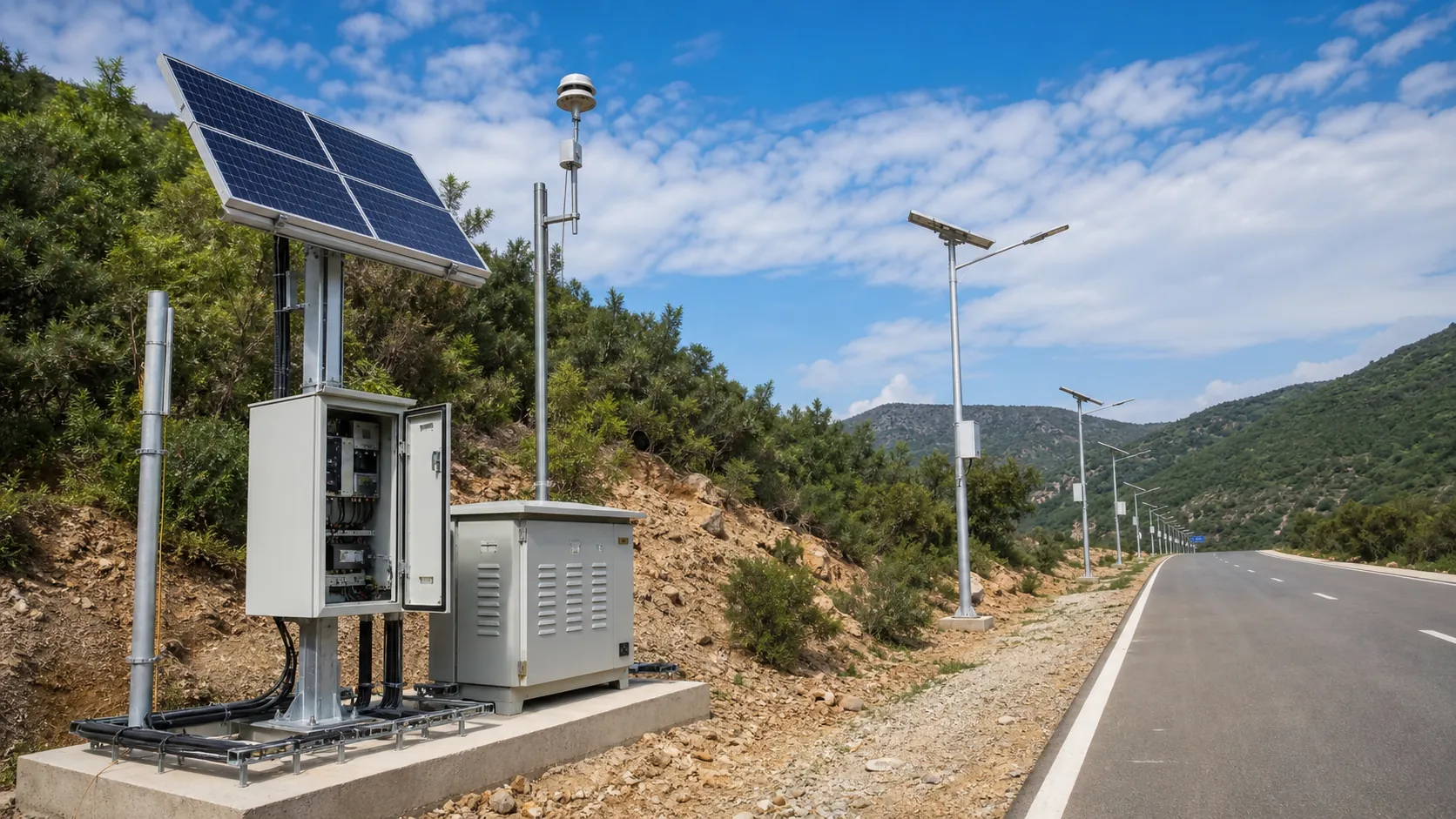
Deploy environmental monitoring stations with sensors, solar power, gateways, dashboards, alarms and data integration for city and industrial sites.
Power and Connectivity
How to choose power, battery, solar, NB-IoT, LTE, LoRaWAN, gateways and monitoring strategy for outdoor IoT infrastructure.
Solar IoT Guide
A design guide for solar-powered outdoor IoT: load calculation, battery autonomy, low-power firmware, telemetry and maintenance planning.
Frequently Asked Questions
What weather measurements can the RC-AWS-200 provide?
Wind speed and direction, air temperature, humidity, pressure, rainfall and solar radiation; sensor selection is project-specific.
Can soil or road sensors be added?
Optional channels include soil moisture and temperature, leaf wetness, visibility, and road-surface temperature or ice sensing.
Can the station operate without mains electricity?
Yes. Solar charging, MPPT control and LiFePO4 storage support off-grid operation; sizing depends on site conditions.
Which communications options suit remote sites?
Options include 4G, NB-IoT and LoRaWAN, with optional satellite backhaul selected according to coverage.
Can weather data feed our existing platform?
Available interfaces include MQTT, REST and Modbus TCP. REDCOAST.LTD also provides a web platform and mobile app.
What happens during a communications outage?
The logger stores readings locally and forwards buffered records when connectivity returns.
Can the mast and enclosure match our site?
Mast height, mounting and environmental configuration are selected for the deployment; a hinged servicing option is available.