Overview
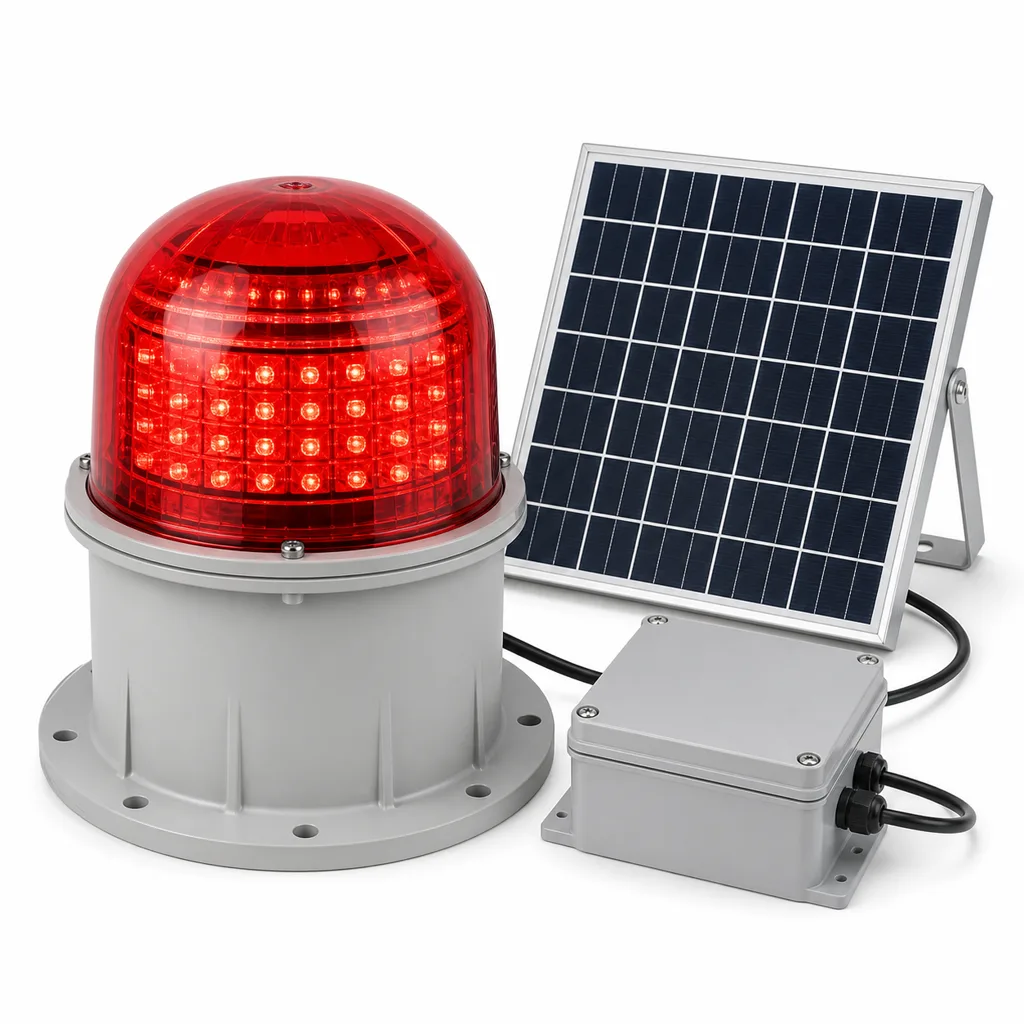
The Redcoast RC-AOL-200 is an off-grid, solar-powered aviation obstruction light (obstacle warning light) system built for tall structures that endanger low-flying aircraft — telecommunication and broadcast towers, wind turbines, chimneys and flare stacks, cooling towers, high-rise buildings, port and construction cranes, transmission line pylons, and bridges. On remote masts and greenfield sites there is often no grid power at the top of the structure, and trenching a cable up a 60–150 m tower is costly and slow. The RC-AOL-200 removes that dependency entirely: each beacon carries its own solar panel, LiFePO4 battery and Redcoast-developed flasher driver, runs autonomously for years, and reports its health back to the operations centre over cellular IoT. It is engineered to satisfy ICAO Annex 14 obstacle-lighting requirements and the FAA AC 70/7460 light types (L-810 / L-864 / L-865), so the same platform can be configured for almost any jurisdiction.
Key Features
- Full intensity range on one platform — low-intensity (Type A/B, 10–32.5 cd steady or flashing red), medium-intensity (Type A white 20,000 cd day / 2,000 cd night, Type B/C red 2,000 cd), and high-intensity white (up to 200,000 cd day) variants share the same mount, controller and IoT layer.
- Redcoast self-developed LED flasher driver PCB — constant-current LED drive, precise effective-intensity regulation, day/twilight/night dimming, and configurable flash character (steady-on, 20/30/40/60 fpm) instead of relying on a generic third-party module.
- GPS flash synchronisation — all beacons on a structure, and across an entire site, flash in unison to the same UTC-locked timebase for a clean, unambiguous signal to pilots.
- Integrated photocell with automatic day/night switching — white-by-day / red-by-night dual-mode operation and automatic intensity step-down at twilight, per ICAO/FAA practice.
- True off-grid autonomy — Redcoast MPPT charge controller, oversized LiFePO4 battery and low-loss optics give 5+ days of cloudy-weather backup with zero external power.
- IoT remote monitoring & alarming — per-beacon lamp status, battery voltage, charge current, photocell state, GPS lock and flash-fault telemetry pushed to the Redcoast cloud/Web + mobile app, with instant lamp-outage alerts (a compliance requirement in most regions).
- Marine-grade enclosure — UV-stable polycarbonate dome, anodised/painted aluminium base, IP66/IP67, salt-fog and sand resistant, rated for high-altitude and high-wind exposure.
- Long service life — high-efficiency red/white LEDs rated ~100,000 h, hot-swappable beacon head, and a design intent of 8–10 years field life with minimal maintenance.
Technical Architecture
Each RC-AOL-200 node is a self-contained light point. A monocrystalline solar panel feeds the Redcoast MPPT power-management PCB, which charges a sealed LiFePO4 pack and supplies a regulated rail to the Redcoast LED flasher driver PCB. The flasher driver runs constant-current strings of high-intensity LEDs (red and/or white), shaping effective intensity, flash rate and duty so the optical output meets the target ICAO/FAA type. An onboard photocell tells the controller whether it is day, twilight or night; the controller then selects the correct colour and intensity step and applies the correct flash character. A GPS receiver locks every beacon to UTC so that all lights on the tower — and neighbouring towers — flash together.
The control logic, flash timing, dimming curves and fault detection are firmware on Redcoast hardware, so behaviour can be tuned per project (for example, switching a medium-intensity head between L-864 red-night and L-865 white-day operation). A cellular IoT module (4G/NB-IoT/LoRa, optionally satellite for the most remote masts) carries telemetry to the Redcoast platform: lamp on/off and current draw per LED string, flash-synchronisation status, battery state of charge, solar yield, enclosure and controller health. Edge logic raises an alarm the moment a beacon drops below its certified intensity or stops flashing, which is exactly what aviation authorities require operators to detect and report. Configuration, firmware updates and intensity profiles can be pushed remotely, so a fleet of towers is managed from one dashboard rather than by climbing each structure.
Connectivity & Power
Connectivity is modular. 4G/5G suits sites with carrier coverage and high reporting frequency; NB-IoT is ideal for low-power, deep-coverage status reporting from steel lattice towers; LoRa links a cluster of beacons on one structure to a single gateway; and a satellite (NTN) option is available for masts with no terrestrial signal at all. A dry-contact / RS-485 interface lets the system integrate into an existing tower BMS or SCADA.
Power is built around true off-grid operation. The MPPT controller harvests maximum yield from a 50–200 W panel and stores it in a 50–200 Ah LiFePO4 pack sized for the beacon's intensity class and the site's solar resource, delivering 5+ autonomous days. For structures where grid or PoE is available at the light point, the same beacon accepts an AC/DC or 24/48 VDC feed with the battery acting as ride-through backup — useful for high-intensity heads whose daytime power demand exceeds what a single panel can supply.
Protection & Reliability
The beacon head uses a UV-stabilised polycarbonate dome over a corrosion-resistant aluminium body; electronics are conformally coated and sealed to IP66/IP67. The system is built for the harshest tower-top conditions: an operating range of -40 to +70 °C, salt-fog endurance for coastal and offshore wind sites, sand and dust resistance for desert masts, and a vibration/wind rating suited to slender high structures. LEDs are driven well within their thermal envelope for a ~100,000 h rated life, and the modular beacon head is hot-swappable so a failed unit is replaced in minutes during a scheduled climb rather than requiring a full fixture change.
Application Scenarios
- Telecom & broadcast towers — steel lattice and monopole masts in remote, off-grid locations where running power to the top is impractical; low- or medium-intensity red beacons report outages automatically for compliance.
- Wind turbines & wind farms — synchronised medium-intensity beacons on nacelles and met masts across a whole farm, GPS-locked so the array flashes as one.
- Industrial chimneys, flare stacks & cooling towers — high-temperature, high-vibration environments needing rugged, sealed beacons with remote health visibility.
- Construction & port cranes — temporary high-intensity or medium-intensity warning on moving structures, battery-backed so they never go dark during a power interruption.
- High-rise buildings & bridges — rooftop and pylon obstruction lighting integrated into building/asset management dashboards.
- Transmission line pylons & spans — marker lighting on tall crossings and river spans where grid tapping at the conductor height is unsafe or impractical.
Case-style Examples
Off-grid telecom tower fleet: An operator managing dozens of remote lattice towers needed each top to stay lit without grid access and to be alerted the instant a beacon failed (a regulatory obligation). Redcoast configured L-810 steady-red plus a single L-864 medium-intensity red top beacon per tower, each solar-powered with NB-IoT telemetry. Lamp-outage alarms now arrive at the NOC in minutes, and climbs are scheduled only when a real fault is confirmed — cutting truck rolls dramatically.
Coastal wind farm: A wind project required synchronised aviation warning across many turbines in a salt-laden environment. Redcoast supplied GPS-synchronised medium-intensity beacons with salt-fog-rated enclosures and a LoRa-to-cellular backhaul, so the entire farm flashes in unison and the developer sees every nacelle light's status on one map.
Construction crane on a high-rise site: A contractor needed temporary obstruction lighting on tower cranes that could not be left dark during site power cuts. Battery-backed solar beacons with magnetic/clamp mounts were deployed and redeployed as the cranes moved, with status visible on the site manager's phone.
Customization & Selection Guide
- Pick the intensity class by structure height and local rules. Structures below ~45 m typically use low-intensity red (L-810). 45–150 m generally calls for medium-intensity (red L-864 at night, optionally white L-865 by day). Above ~150 m, high-intensity white (up to 200,000 cd) is usually required. Confirm against the governing ICAO/FAA/national specification for the site.
- Match power to intensity and climate. Low/medium red beacons run comfortably solar-only with a 50–100 W panel; high-intensity white daytime output is power-hungry, so specify the larger panel/battery or a hybrid grid-backup feed.
- Choose connectivity for the site. Carrier coverage → 4G/NB-IoT; clustered beacons on one mast → LoRa to a single gateway; no terrestrial signal → satellite NTN.
- Single vs. dual mode. Specify dual white-day/red-night heads where authorities require white daytime visibility; otherwise red-only low/medium beacons are simpler and cheaper.
- Mounting. Pole-top, side-mount bracket, flange, or magnetic/clamp for temporary crane use — Redcoast adapts the base to the structure.
Deployment & After-sales
Beacons ship pre-configured to the agreed intensity type and flash profile, so field work is mechanical mounting plus a quick GPS/IoT commissioning check via the app — no power cabling to the light point. Redcoast provides mounting brackets and an installation guide, remote firmware/profile updates, the Web + mobile monitoring platform, and engineering support for compliance documentation. Spare hot-swap beacon heads can be stocked on site for fast restoration. Lead time scales with intensity class and quantity and is confirmed per project.
Standards & Compliance
Designed to meet ICAO Annex 14, Volume I, Chapter 6 obstacle-lighting requirements and the FAA AC 70/7460 light-type framework (L-810 steady/flashing red ≥32.5 cd, L-864 medium-intensity red 2,000 cd, L-865 medium-intensity white 20,000 cd day / 2,000 cd night, and high-intensity white systems). Component and system certification directions include CE, RoHS, IEC 60598 (luminaires) and IP66/IP67 ingress protection, with national civil-aviation approvals supported on a per-market basis. Redcoast aligns the optical performance, flash rate (20–60 fpm) and monitoring/alarm behaviour to the specification governing each deployment.
Why Redcoast
Redcoast designs and builds the hardware itself — the LED flasher driver PCB, MPPT power-management board and IoT controller are our own board-level designs, paired with our self-developed Web and mobile management platform. That means we tune effective intensity, flash character, day/night logic and fault thresholds to the exact standard your project answers to, integrate the telemetry your operations team needs, and open new PCBs when a structure or jurisdiction demands something off-the-shelf vendors can't deliver. Software-and-hardware as one, customised per project, built to survive on a tower top for a decade.
Tell us your structure height, the governing standard (ICAO / FAA / national) and your site's power and signal conditions — Redcoast will configure or custom-build the obstruction lighting system that keeps your asset compliant and visible. Contact us for a tailored proposal.
Specifications
Light Performance
- Low Intensity (Type A/B)
- 10 / 32.5 cd
- Medium Intensity Red (L-864)
- 2,000 cd
- Medium Intensity White (L-865)
- 20,000 day / 2,000 night cd
- High Intensity White (optional)
- up to 200,000 cd
- Light Colour
- Aviation Red / White (single or dual mode)
- Flash Character
- Steady-on or flashing 20/30/40/60 fpm
- Beam Coverage
- 360° horizontal
Optics & LED
- Light Source
- High-intensity red/white LED array
- Rated LED Life
- ~100,000 h
- Dimming
- Auto day / twilight / night step-down
- Photocell Switching
- Automatic, dual-mode
Solar Power System
- Solar Panel
- Monocrystalline 50-200 W
- Charge Controller
- Redcoast MPPT
- Backup Autonomy
- 5+ (cloudy days) days
- Optional Mains Backup
- AC/DC or 24/48 VDC
Battery
- Chemistry
- LiFePO4
- Capacity
- 50-200 Ah
- Cycle Life
- >3,000 (80% DoD) cycles
- Battery Mgmt
- Integrated BMS, over-charge/discharge protection
Control & Connectivity
- Flash Synchronisation
- GPS / UTC-locked
- Cellular IoT
- 4G/5G, NB-IoT
- Local Link
- LoRa to gateway
- Remote Option
- Satellite NTN
- Wired Interface
- RS-485 / dry contact (SCADA/BMS)
- Telemetry
- Lamp status, battery, solar, GPS, fault alarm
Mechanical & Protection
- IP Rating
- IP66 / IP67
- Dome Material
- UV-stabilised polycarbonate
- Body Material
- Corrosion-resistant aluminium alloy
- Mounting
- Pole-top / side bracket / flange / clamp
- Salt-fog / Sand
- Resistant (coastal & desert rated)
Environmental
- Operating Temperature
- -40 to +70 ℃
- Humidity
- 0-100 %RH
- Wind / Vibration
- High-mast / turbine rated
- Design Service Life
- 8-10 years
Capabilities — configurable per project
Specifications are tailored to each project — the options below show what we can support.
Intensity Class
- Low-intensity red (L-810)
- Medium-intensity red (L-864)
- Medium-intensity white (L-865)
- High-intensity white
Power
- Solar off-grid
- Solar + mains backup
- Grid/PoE with battery ride-through
Connectivity
- 4G/5G
- NB-IoT
- LoRa
- Satellite NTN
Operating Mode
- Red-only night
- Dual white-day / red-night
- Steady-burning
- Flashing (20-60 fpm)
Mounting
- Pole-top
- Side bracket
- Flange
- Magnetic/clamp (temporary)
Related solution guidance
Solar IoT Guide
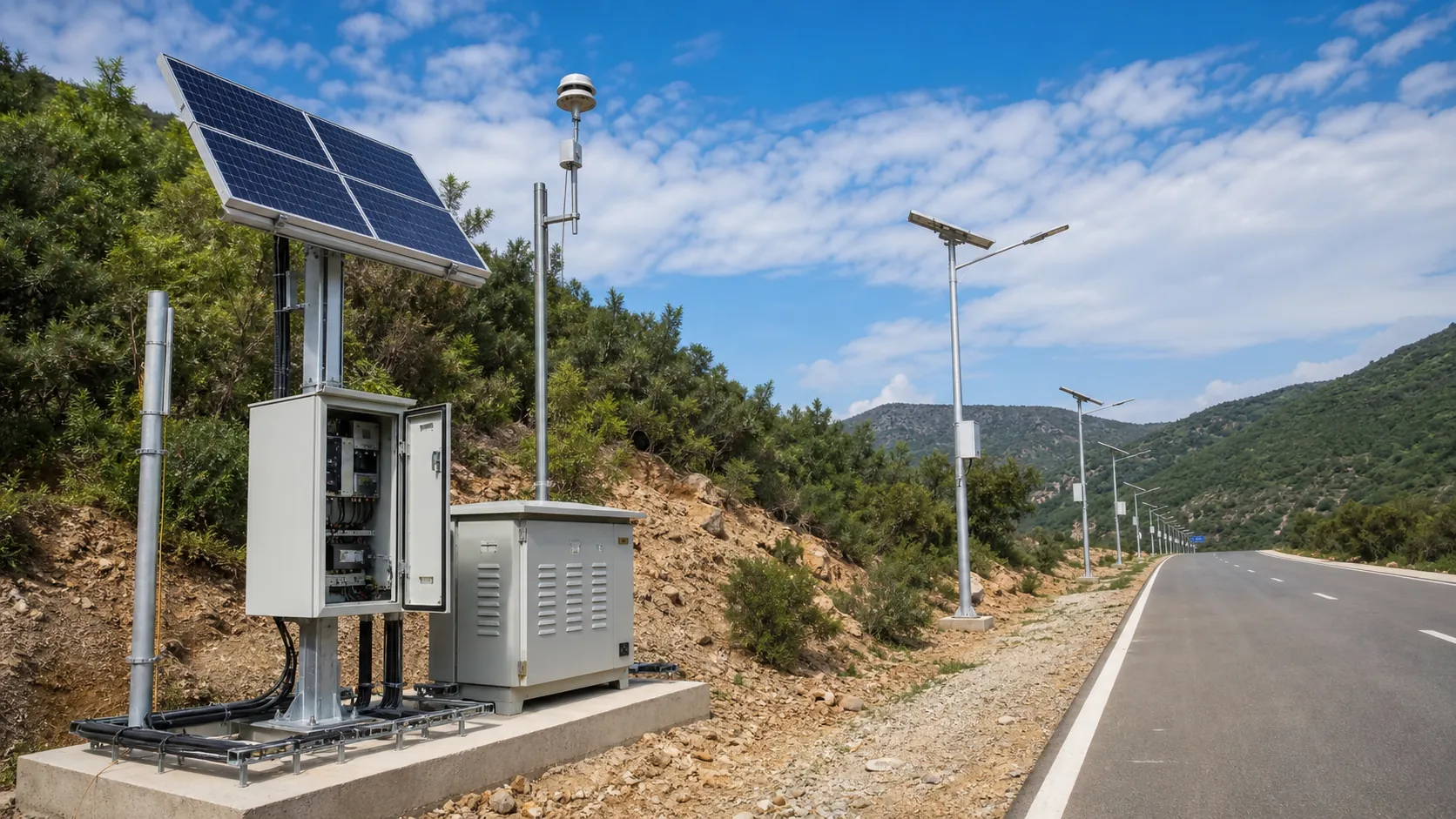
A design guide for solar-powered outdoor IoT: load calculation, battery autonomy, low-power firmware, telemetry and maintenance planning.
Solar Off-Grid IoT
Design solar-powered outdoor IoT systems with panels, batteries, controllers, low-power devices, gateways and remote power monitoring.
Traffic Safety Checklist
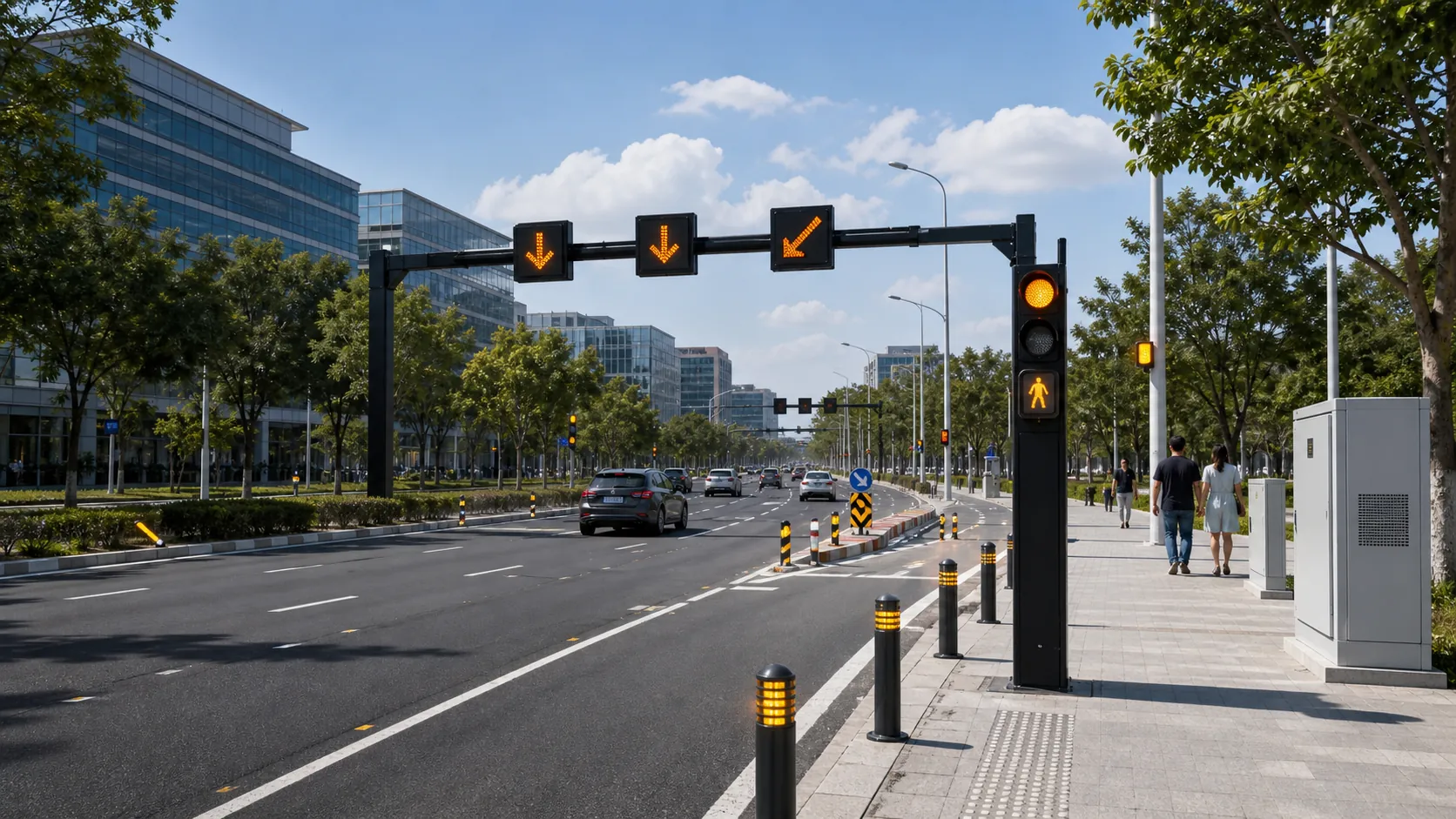
Deployment checklist for connected traffic warning signs, beacons, road guidance devices, power, visibility, monitoring and acceptance tests.
Frequently Asked Questions
What is an aviation obstruction light and when is it required?
An aviation obstruction (obstacle warning) light marks tall structures that could be a hazard to aircraft. ICAO Annex 14 and national civil-aviation rules generally require lighting on obstacles above defined heights — commonly from around 45 m, with stricter requirements above 150 m. Typical structures include telecom towers, wind turbines, chimneys, cranes, high-rise buildings and transmission pylons.
What is the difference between low, medium and high intensity obstruction lights?
Low-intensity lights (ICAO Type A/B, FAA L-810) are steady or flashing red at about 10–32.5 cd, used on shorter structures. Medium-intensity lights are 2,000 cd red (L-864) at night and 20,000 cd white (L-865) by day, for structures roughly 45–150 m. High-intensity white lights reach up to 200,000 cd by day and are used on the tallest structures. The RC-AOL-200 covers all classes on one platform.
Can the light run without grid power on a remote tower?
Yes. The RC-AOL-200 is designed off-grid: each beacon has its own monocrystalline solar panel, REDCOAST.LTD MPPT controller and LiFePO4 battery sized for 5+ days of cloudy-weather autonomy. This avoids running power cables up tall masts. A grid or 24/48 VDC backup feed is optional, mainly for power-hungry high-intensity white heads.
Does it support remote monitoring and lamp-failure alarms?
Yes. Most aviation authorities require operators to detect and report a light outage. Each beacon reports lamp status, drive current, battery state, solar yield, GPS lock and flash-fault telemetry over 4G/NB-IoT/LoRa (satellite optional) to the REDCOAST.LTD Web and mobile platform, which raises an instant alarm if a light drops below its certified intensity or stops flashing.
How do multiple lights on a tower or wind farm flash together?
Every beacon has a GPS receiver and locks its flash timing to UTC. This synchronises all lights on a structure — and across an entire site or wind farm — so they flash in unison, presenting a single clear signal to pilots as required by ICAO/FAA practice.
Which standards does the REDCOAST.LTD obstruction light meet?
It is designed to ICAO Annex 14, Volume I, Chapter 6 and the FAA AC 70/7460 light-type framework (L-810, L-864, L-865 and high-intensity white). Component/system certification directions include CE, RoHS, IEC 60598 and IP66/IP67, with national civil-aviation approvals supported per market. REDCOAST.LTD tunes intensity, flash rate and alarm behaviour to the governing standard for each project.
Can REDCOAST.LTD customise the light for our structure and regulations?
Yes. REDCOAST.LTD designs the LED flasher driver, MPPT power board and IoT controller in-house and can open new PCBs, so we configure intensity class, single/dual colour mode, flash character, mounting and connectivity to your structure height, climate and the standard you must comply with.
What is the expected service life and maintenance?
LEDs are rated around 100,000 hours and the system is built for an 8–10 year field life in harsh tower-top conditions (-40 to +70 °C, salt fog, sand, high wind). The beacon head is hot-swappable, so maintenance is fast, and IoT alarms mean crews climb only when a real fault is confirmed.