Overview
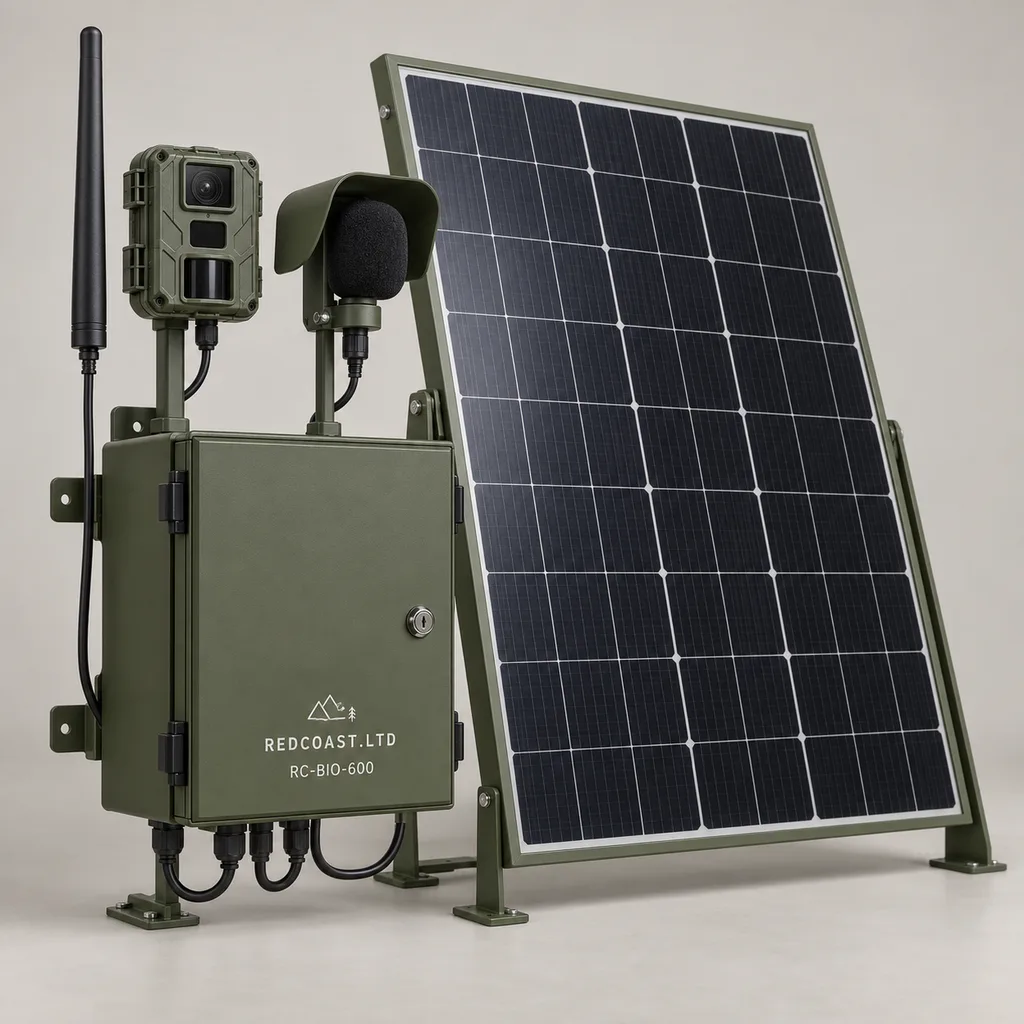
The RC-BIO-600 is a configurable biodiversity monitoring node that combines passive acoustic recording, AI-assisted bird-call identification, infrared wildlife imaging, and remote equipment management. Designed for protected-area managers, ecological consultancies, research teams, and conservation infrastructure integrators, it collects evidence from remote habitats where repeated field visits are difficult and grid connections are unavailable. REDCOAST.LTD brings the field hardware, solar power system, Web platform, and mobile app into one project delivery, supported by in-house PCB and board-level hardware development. The specification below defines a proposed engineering reference configuration; final performance, component selection, and compliance evidence are established during project qualification.
Key Features
- Complementary acoustic and visual evidence: Scheduled sound recordings document vocal activity, while a separate PIR-triggered infrared camera records animals crossing a selected observation zone.
- AI bird-call screening with reviewable evidence: Candidate identifications retain the original audio, timestamp, model version, and confidence score so ecologists can verify important records.
- Research-oriented recording: Selectable 24, 48, or 96 kHz sampling and 16-bit or 24-bit PCM WAV storage accommodate different survey protocols without forcing recordings into a proprietary audio format.
- Low-disturbance night observation: A 940 nm infrared illuminator provides monochrome night images without a white-light flash; its output and operating schedule are configurable.
- Practical remote communications: 4G uploads health reports, species candidates, thumbnails, and selected evidence clips while retaining bulk recordings locally.
- Solar operation with an explicit energy budget: The reference configuration pairs a 160 Wp photovoltaic module with a 768 Wh LiFePO4 battery and separately switched recording, processing, camera, and modem power rails.
- Unified fleet management: A Web map and mobile app expose recording schedules, battery condition, storage occupancy, upload queues, and maintenance history across multiple monitoring sites.
- Project-specific hardware development: REDCOAST.LTD can design new acoustic front-end, camera-interface, sensor-interface, and power-management PCBs to match the survey and installation requirements.
Technical Architecture
The node separates continuous or scheduled data acquisition from higher-power processing. A low-power recording controller manages a replaceable microphone, low-noise analog conditioning, anti-alias filtering, and an audio ADC. A dedicated camera subsystem remains ready for PIR events and captures locally without waiting for the Linux processing board or cellular modem to start. The reference design uses one microphone and one camera; a second acoustic channel is an engineering option. Microphones mount away from vibrating panel brackets, cable movement, and rain impact on the main enclosure.
Recorded audio enters local storage before inference. A scheduled edge processor converts selected recordings into model inputs, applies an agreed bird-species classifier, and creates candidate detections linked to the original files. The platform distinguishes unreviewed, confirmed, rejected, and unresolved identifications. Acoustic and camera records share a site identifier and synchronized clock, but a coincident photograph is not automatically treated as proof that the photographed animal produced a recorded call. Amphibian or other taxonomic classifiers require separately validated models and training coverage.
The cloud or customer-hosted platform manages review queues, spectrogram playback, image inspection, recording effort, and exports. Confidence thresholds are evaluated against annotated local recordings, including difficult weather and background conditions. BirdNET research highlights the importance of species-specific threshold selection; detector scores should not be presented as universally calibrated probabilities. The RC-BIO-600 therefore specifies a validation workflow rather than a blanket identification-accuracy percentage. Cornell BirdNET research and best practices.
Connectivity & Power
The reference communications package uses 4G LTE Cat 1 bis with a deployment-appropriate modem variant, antenna, SIM, and operator plan. Transfers use authenticated HTTPS or MQTT over TLS, with resumable evidence uploads and local queues during outages. A service Wi-Fi interface is enabled during maintenance, while an optional LoRaWAN interface carries compact health messages and detection summaries. LoRaWAN is not used to transport photographs, audio archives, or video. Sites without cellular service continue recording locally; routine remote evidence access requires a separately engineered backhaul solution.
Solar power is selected because the intended deployment is an isolated monitoring plot without a practical grid connection. The 160 Wp panel must receive direct sunlight, even when the microphone and camera are positioned beneath vegetation. A separate panel rack at a nearby clearing is preferable to placing the panel under a closed canopy. Cable length, voltage drop, panel open-circuit voltage at low temperature, and local lightning exposure are checked during engineering.
The reference daily allowance is 144 Wh, equivalent to a 6 W average load, covering continuous 48 kHz mono recording, scheduled inference, up to 100 ten-second camera events, and limited cellular upload windows. This is a design allowance to verify with the selected hardware and model, not a measured production result. At 80% battery depth of discharge and 90% delivery efficiency, the 12.8 V, 60 Ah battery supplies approximately 553 Wh to the loads, giving 3.8 calculated days without solar input at room temperature. A practical planning figure is three days before additional allowances for cold, aging, or heating. At two equivalent peak-sun hours and a combined 0.65 derating factor, the 160 Wp panel produces approximately 208 Wh per day; this supports the reference load with limited recovery margin, so extended cloudy-season deployments may require the 240 Wp and 100 Ah options.
Protection & Reliability
The electronics enclosure and camera housing have an IP66 design target, subject to testing of the final assembly. The microphone uses a downward-facing rain hood, replaceable windscreen, and acoustically suitable protective membrane; its acoustic opening is not represented as immersion-proof. This distinction follows established recorder practice: Wildlife Acoustics explicitly separates its enclosure protection rating from microphone exposure limitations. Song Meter Mini 2 physical specifications.
Steel cabinets, mounting poles, and brackets use a hot-dip galvanized corrosion-protection base with a smooth matte powder-coated or fluorocarbon-painted finish. Coastal projects can specify a more resistant coating system, sealed connectors, and corrosion-resistant fasteners. Replaceable desiccant, a pressure-equalization vent, conformal coating on appropriate PCB areas, and protected cable entries reduce moisture-related failures. Dust, insects, spider webs, salt deposition, and microphone windscreen deterioration remain inspection items.
The standard system operating design range is -20 to +50°C, with battery charging permitted only between +5 and +45°C. An optional thermostatic heater requires its own winter energy allowance; it is excluded from the reference autonomy calculation. Temperature-controlled charging is essential for LiFePO4 systems, as illustrated by published battery operating guidance. Victron lithium battery operating conditions. Structural design is checked against the actual panel area, mounting height, foundation, and site wind conditions. Replaceable microphones, batteries, storage media, and camera modules support maintenance without discarding the complete node.
Application Scenarios
Protected forest monitoring plots
Install acoustic heads at representative forest plots and cameras along selected animal paths, with solar panels positioned in nearby sunlit openings. Repeated recording schedules provide comparable evidence of vocal activity and terrestrial animal passage while reducing dependence on frequent manual collection visits.
Wetland margins and amphibian habitats
Place microphones above expected flood levels and cameras on stable banks or raised supports. Night recording windows can capture amphibian choruses and nocturnal bird activity, while image records document visible animals using the shoreline; species classification depends on the models selected for the project.
Habitat restoration monitoring
Deploy matched configurations across restored plots and reference habitats, keeping gain, microphone height, recording schedules, and model versions documented. The resulting evidence supports comparisons through time, with recording effort and equipment downtime available alongside candidate species records.
Wildlife corridors and reserve boundaries
Position cameras across narrow movement routes and acoustic heads where surrounding vocal activity can be sampled with limited mechanical noise. The combined dataset helps teams investigate habitat use, although acoustic detections and camera encounters require appropriate ecological analysis before making abundance or occupancy claims.
Seasonal research stations
Use removable mounting kits for breeding-season surveys, migration studies, or temporary monitoring campaigns at sites without power infrastructure. Local storage preserves recordings during communication gaps, and redeployment records keep changes in site position and survey effort traceable.
These applications reflect established conservation demand for complementary camera trapping and passive acoustic monitoring, including the practical challenge of processing large recording volumes. WWF conservation technology guidance.
Case-style Examples
The following examples are illustrative deployment designs, not claims of completed customer installations.
Forest restoration comparison: A project needs consistent observations from twelve restored plots and twelve reference plots. Each node uses the same 48 kHz recording schedule, microphone gain, and camera settings, with 160 Wp panels placed in approved openings. The intended outcome is a traceable dataset of reviewed detections and monitoring effort that analysts can compare without confusing equipment-setting changes with ecological change.
Wetland breeding-season survey: A survey team needs dusk-to-dawn recordings and visual evidence from bank-side animal routes. The proposed configuration adds a second microphone channel, short infrared camera clips, and a 240 Wp panel with a 100 Ah battery after checking seasonal solar availability. The larger energy reserve accommodates the expanded recording workload, while shortlisted clips and thumbnails give reviewers access to evidence between field visits.
Mountain reserve with intermittent coverage: A monitoring plot has cellular service only during favorable network conditions and experiences freezing nights. The design uses local recording, queued uploads, a protected battery compartment, and charge-temperature interlocks; any heater is sized against the cold-season energy budget. Equipment logs allow the team to distinguish missing uploads from actual recording interruptions and plan recovery visits accordingly.
Customization & Selection Guide
Start with the ecological question: target species, required evidence, survey season, habitat structure, and acceptable collection interval. A single microphone at 48 kHz is an economical starting point for audible bird calls. Select a second channel when the protocol requires it, and use 96 kHz only when the target signal and microphone response justify the additional storage and processing. The standard acoustic head is designed for audible wildlife monitoring; higher sampling alone does not turn it into a validated ultrasonic bat recorder.
Camera selection depends on animal size, movement speed, expected distance, and the need for stills versus behavioral clips. The reference 5 MP native sensor avoids inflated interpolated-resolution claims. A 940 nm illuminator reduces visible glow, but its effect on the target species and the required identification distance should be assessed in a pilot. Infrared imaging here means near-infrared illumination and image capture, not thermal imaging.
Storage and connectivity should be sized together. Uncompressed 48 kHz, 24-bit mono audio requires approximately 12.44 GB per day of continuous recording. Allocating 80% of a nominal 512 GB card to audio gives approximately 32 days of audio-only capacity before filesystem overhead; camera media and operational reserves reduce that figure. A one-minute-in-five schedule cuts audio volume substantially, while preserving a documented sampling design. Established commercial recorders similarly provide selectable sampling rates, local WAV storage, and configurable schedules. Wildlife Acoustics recorder specifications.
Select a commercially licensed classifier or a customer-authorized model with documented rights for the intended use. BirdNET integration, if requested, requires specific licensing review because the published model terms differ from the source-code license. It is not included as an unrestricted commercial model by default. BirdNET-Analyzer licensing.
Deployment & After-sales
Deployment begins with a solar-access assessment, cellular signal survey, microphone noise assessment, and trial camera placement. Typical microphone height is 1.5–2.5 m, while camera height is selected around the target species, commonly 0.3–1.0 m for terrestrial mammals. The installation drawing defines cable protection, drip loops, service access, earthing where required, and mounting methods that avoid unnecessary habitat damage.
Commissioning checks cover audio quality, trigger response, night exposure, clock synchronization, upload recovery, and measured daily energy consumption. A two-to-four-week field pilot is recommended before fixing fleet-wide settings. Delivery planning separates engineering, prototype fabrication, field evaluation, and production; an initial planning allowance is 8–12 weeks after specification agreement, with new tooling or certification work scheduled separately.
Project handover includes wiring diagrams, configuration records, maintenance instructions, platform training, and a replaceable-parts list. Remote diagnostics support microphone faults, storage errors, battery deterioration, and failed uploads. Warranty duration, spare-parts availability, hosting arrangements, and support response times are defined in the project quotation rather than assumed from generic product claims.
Standards & Compliance
Qualification is planned around the actual bill of materials and installation. Enclosure ingress testing follows the relevant provisions of IEC 60529; photovoltaic module procurement can specify IEC 61215 qualification evidence; and the industrial lithium battery package can specify IEC 62619 safety evidence. These references describe applicable assessment routes and do not establish certification of the complete RC-BIO-600 assembly. IEC 60529, IEC 61215-1-1, and IEC 62619.
The delivery plan also identifies applicable radio approvals, EMC testing, material restrictions, and battery transport documentation for the destination. CE, RoHS, FCC, or other conformity claims are made only against the supplied configuration and supporting documents. Platform configuration includes access roles, sensitive-species coordinate restrictions, retention settings, and controlled exports. Monitoring locations and recording practices should follow the protected area's permissions and research protocol.
Why REDCOAST.LTD
REDCOAST.LTD delivers the complete monitoring solution: outdoor hardware, power engineering, firmware, a Web management platform, a mobile app, and integration interfaces. In-house PCB development provides control over microphone conditioning, electrical noise, camera triggering, power sequencing, environmental sensor interfaces, and maintenance diagnostics. This enables the hardware to follow the ecological monitoring requirement instead of forcing the project to accept a fixed collection of consumer devices.
Projects can begin with standard sensing and communication modules, then introduce purpose-designed boards where the requirements justify them. The same engineering team can coordinate the enclosure, electronics, firmware, evidence workflow, and platform interfaces, giving buyers a clear path from pilot findings to a repeatable monitoring fleet.
Contact REDCOAST.LTD with your target species, site conditions, recording schedule, and connectivity requirements to configure an RC-BIO-600 biodiversity monitoring deployment.
Specifications
Acoustic Acquisition
- Acoustic Channels
- 1 standard; 2 optional channels
- Sampling Rates
- 24 / 48 / 96 kHz
- Recording Format
- 16-bit or 24-bit PCM WAV
- Microphone Passband Design Target
- 100–20000; final response characterized with protective membrane fitted Hz
- Programmable Analog Gain
- 0–36 in 6 dB steps dB
- Recording Schedules
- Continuous; fixed windows; sunrise/sunset offset; 1 minute every 5 minutes
- Candidate Evidence Clip Length
- 6 / 15 / 30 / 60 s
PIR-Triggered Infrared Camera
- Native Image Sensor Resolution
- 5; no interpolated megapixel claim MP
- Video Recording
- 1920 × 1080, H.264, up to 30 fps; night frame rate depends on exposure pixels
- Horizontal Field of View
- 60 standard; 90 optional lens degrees
- Infrared Illumination Wavelength
- 940 nm
- Night Imaging Working Distance
- 10–15 planning range; subject reflectance and exposure dependent m
- PIR Detection Planning Distance
- 10–20 for medium-to-large mammals; temperature contrast dependent m
- First-Still Trigger Latency Target
- 0.3–0.5 from camera standby; excludes network upload s
- Event Capture Settings
- 1–3 stills; 5 / 10 / 20 second video clips
Edge Processing and Evidence Management
- Reference Processor
- Quad-core Arm Cortex-A55 class, 1.4–1.8 GHz
- Memory
- 2 standard; 4 optional GB
- Operating-System Storage
- 16 eMMC GB
- Removable Evidence Storage
- 512 standard; 1024 optional high-endurance media GB
- Reference Continuous Audio Volume
- 12.44 at 48 kHz, 24-bit, mono; excludes images and video GB/day
- Clock Synchronization Target
- Within 1 second after successful GNSS or network synchronization; holdover drift logged
- Review States
- Unreviewed / Confirmed / Rejected / Unresolved
- Evidence and Metadata Exports
- WAV / JPEG / MP4 / CSV / JSON; site ID, UTC timestamp, model version, review status
Connectivity and Interfaces
- Primary Cellular Connection
- 4G LTE Cat 1 bis; band set selected for deployment
- SIM Interface
- 1 nano-SIM slot
- Application Protocols
- HTTPS and MQTT over TLS 1.2 or later
- Maintenance Wireless Interface
- 2.4 GHz Wi-Fi; service mode only
- Optional Low-Rate Telemetry
- LoRaWAN 1.0.4; deployment-specific channel plan; metadata only
- External Sensor Interface
- 1 isolated RS-485 port, Modbus RTU, 9600–115200 baud
- Health Reporting Interval
- 15 / 30 / 60 / 360 min
- Daily Upload Budget Setting
- 10–500; excess evidence queued locally MB/day
Solar Power and Energy Budget
- Photovoltaic Module Rating
- 160 standard; 240 optional, at STC Wp
- LiFePO4 Battery
- 12.8 V, 60 Ah, 768 Wh standard; 100 Ah, 1280 Wh optional
- MPPT Charge Controller
- 20 A charge output; 75 V maximum PV open-circuit input
- Reference Daily Load Allowance
- 144; 6 W average, including scheduled AI and limited uploads; excludes heater Wh/day
- Peak System Load Design Allowance
- 25 excluding optional battery heater W
- No-Sun Autonomy
- 3 planning days; 3.8 calculated at 25°C, 80% depth of discharge, 90% delivery efficiency, 144 Wh/day
- Reference Solar Yield
- 208 at 160 Wp × 2 peak-sun hours × 0.65 derating factor Wh/day
- Battery Charge Temperature Window
- +5 to +45; charging inhibited outside range °C
Mechanical and Environmental Design
- Enclosure Protection Target
- IP66 for controller and camera assemblies; exposed acoustic head rain-protected, not immersion-rated
- System Operating Temperature Target
- -20 to +50; battery charging subject to separate limits °C
- Ambient Humidity Design Range
- 5–95; prevent internal condensation through enclosure moisture management % RH
- Controller and Battery Cabinet Reference Dimensions
- 400 × 300 × 200, excluding brackets and connectors mm
- Steel Surface Treatment
- Hot-dip galvanized base plus smooth matte powder coating; RAL 6003 or RAL 7016
- Pole Clamp Diameter
- 60–114 mm
- Suggested Sensor Mounting Heights
- Microphone 1.5–2.5 m; terrestrial-mammal camera 0.3–1.0 m
- Reference Structural Wind Design Target
- 40 m/s gust; panel, support, anchors, and foundation require site-specific verification
Capabilities — configurable per project
Specifications are tailored to each project — the options below show what we can support.
Survey and Acoustic Hardware
- Single-channel audible bird monitoring
- Dual-channel audible soundscape recording
- Additional amphibian classifier with project-specific validation
- External temperature and humidity sensor via RS-485
Camera Configuration
- 60-degree lens with 940 nm infrared illumination
- 90-degree lens for wider observation zones
- Still-image priority with 1–3 images per trigger
- Short-video priority with 5–20 second clips
Off-Grid Energy Package
- 160 Wp panel with 12.8 V 60 Ah LiFePO4 battery
- 240 Wp panel with 12.8 V 100 Ah LiFePO4 battery
- Separated solar rack for a nearby sunlit clearing
- Thermostatic battery heater with recalculated winter energy budget
Communications
- 4G evidence upload and remote management
- Local recording with scheduled field retrieval
- 4G plus LoRaWAN health telemetry
- Directional cellular antenna package after signal survey
Platform and Hardware Integration
- Managed Web platform and mobile app
- Customer-hosted platform with REST API integration
- Customer-authorized AI model and taxonomy workflow
- New acoustic, interface, or power-management PCB design
Related solution guidance
Power and Connectivity
How to choose power, battery, solar, NB-IoT, LTE, LoRaWAN, gateways and monitoring strategy for outdoor IoT infrastructure.
Ports and Logistics
Outdoor IoT infrastructure for ports, yards and logistics areas: lighting, guidance, safety, solar power, monitoring and maintenance visibility.
Solar IoT Guide
A design guide for solar-powered outdoor IoT: load calculation, battery autonomy, low-power firmware, telemetry and maintenance planning.
Frequently Asked Questions
What does an acoustic and infrared biodiversity monitoring node record?
The RC-BIO-600 records wildlife sounds and captures PIR-triggered photographs or short infrared night videos. AI processing proposes bird-species candidates while preserving the underlying recordings for review. Acoustic and visual observations complement each other, but they sample different detection zones and do not automatically confirm the same individual.
How accurate is AI bird-call identification in a protected area?
Accuracy depends on the species, habitat, recording quality, background noise, and selected model. REDCOAST.LTD proposes validation against expert-annotated site recordings, with per-species thresholds and documented precision and recall where sufficient examples exist. A confidence score is not a guaranteed probability that the species is present, and consequential records should retain human review.
Can the solar monitoring node operate beneath a dense forest canopy?
The microphone and camera can be positioned beneath vegetation, but the solar panel needs adequate direct sunlight. A panel installed in a nearby clearing can supply the node through an engineered cable route. Where no suitable solar exposure exists, the project needs a different energy plan rather than assuming that a larger panel will overcome continuous shade.
How long can the node operate without sunlight?
The reference 768 Wh battery provides approximately 553 Wh of usable delivered energy after allowing for 80% depth of discharge and 90% delivery efficiency. At the 144 Wh daily design load, calculated autonomy is 3.8 days at room temperature, with three days used for preliminary planning. Cold weather, battery aging, heater operation, additional camera events, and longer uploads reduce that duration.
Does the infrared camera use thermal imaging or visible flash?
The reference camera uses 940 nm near-infrared illumination and produces monochrome night images; it is not a thermal imager. It does not require a white-light flash, although illumination settings and potential wildlife disturbance should still be assessed for the study species. PIR detection distance and usable image distance vary with temperature contrast, vegetation, animal size, and exposure.
What happens when 4G coverage is unavailable, and how much data is uploaded?
Recordings continue locally and selected uploads remain queued until the connection returns, subject to available storage and the configured retention policy. A daily upload allowance of 10–500 MB can prioritize health data, thumbnails, and evidence clips. Continuous 48 kHz, 24-bit mono audio generates approximately 12.44 GB per day, so routine transmission of the complete archive requires a separate bandwidth and energy budget.
Can REDCOAST.LTD customize the electronics and connect the node to our biodiversity database?
Yes. REDCOAST.LTD can develop project-specific acoustic acquisition, camera-interface, sensor-interface, and power-management PCBs alongside firmware, a Web platform, and a mobile app. CSV and JSON exports or a REST API can connect reviewed records and evidence references to an existing database. AI model licensing, taxonomic identifiers, coordinate-access permissions, and acceptance tests are defined during project engineering.