Overview
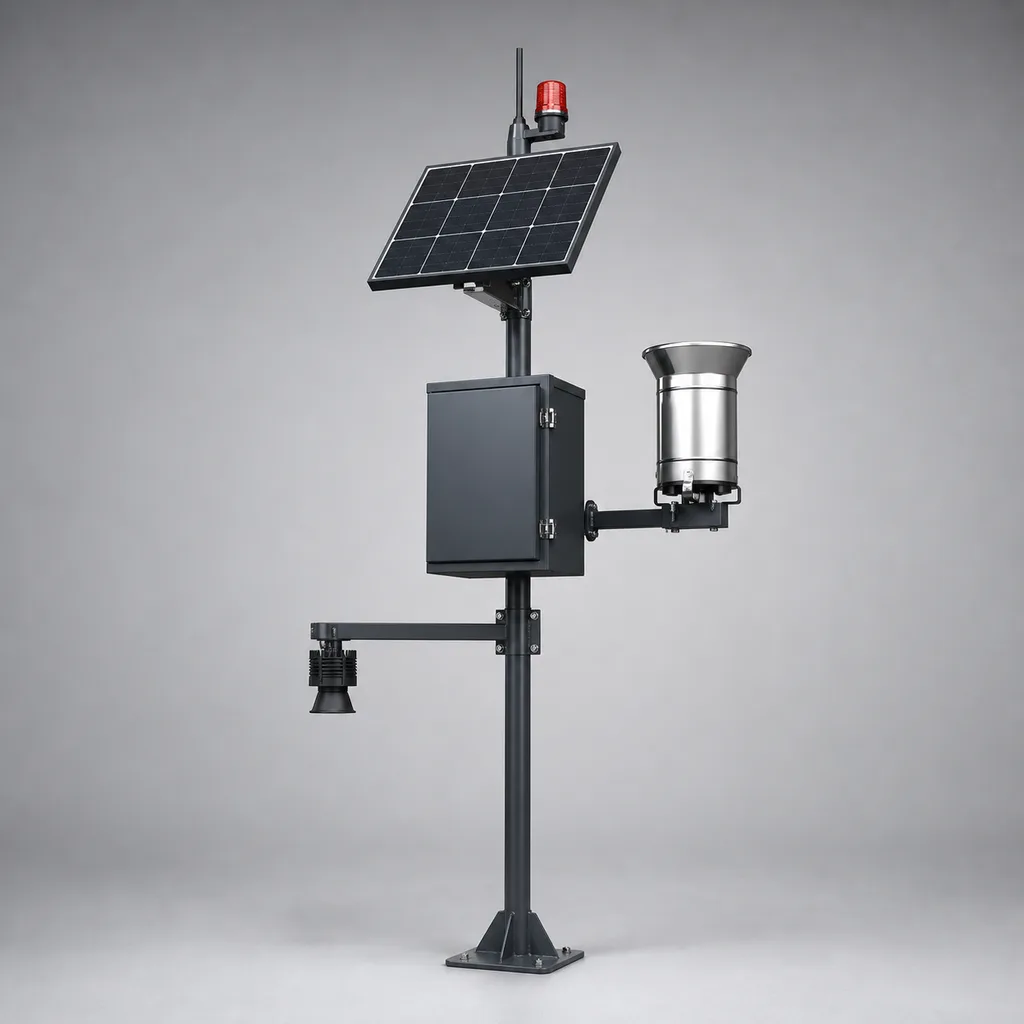
Redcoast's RC-FWS-200 Off-Grid Solar Flood Early Warning & Hydrological Monitoring Station is a self-powered, IoT-connected field cabinet built to continuously measure water level, rainfall and related hydro-meteorological variables at rivers, streams, urban drainage outfalls, dams, culverts, bridges and flash-flood-prone wadis. It is engineered for unattended operation in remote, grid-less, climatically harsh environments and is designed for hydrology bureaus, municipal flood-control agencies, water utilities, road authorities and system integrators delivering early-warning networks. By combining non-contact radar level sensing, WMO-compatible tipping-bucket rainfall measurement, a Redcoast-designed MPPT and signal-conditioning PCB stack, and an edge-intelligent IoT gateway, the station delivers reliable real-time data, threshold-based alarms and optional local siren/strobe warning — letting authorities act minutes, not hours, before a flood event escalates.
Key Features
- Non-contact 80 GHz FMCW radar water level sensor with millimetre-class resolution, immune to spray, foam, floating debris, humidity and temperature drift
- WMO-compatible tipping-bucket rain gauge interface (0.2 mm resolution) with hardware debounce, surge protection and self-clean event reporting
- Redcoast-designed signal-conditioning PCB exposing SDI-12, RS-485 Modbus, isolated 4–20 mA and digital pulse channels in parallel
- Custom MPPT solar charge controller with low-temperature charging cut-off, over/under-voltage protection and full battery health telemetry
- LiFePO4 battery pack engineered for 7–14 days of full autonomy with zero solar input
- Edge-intelligent IoT gateway with configurable rate-of-rise alarms, multi-stage water-level thresholds and store-and-forward buffering
- Multi-bearer communications: 4G LTE, NB-IoT, LoRaWAN and optional Iridium SBD satellite for sites without cellular coverage
- Optional integrated siren + RGB strobe warning beacon for in-situ public alerting at flash-flood crossings
- Optional HD camera with edge snapshot/video capture on alarm event for visual verification
- Lockable IP66 cabinet on a powder-coated mounting pole or bridge bracket; modular, field-replaceable sensors, radio, battery and PCB stack
Technical Architecture
The RC-FWS-200 is built around a Redcoast-engineered three-board PCB stack housed in the station's IP66 cabinet. The bottom board is the MPPT power-management board, which extracts maximum power from the solar array, manages charging of the LiFePO4 pack with full temperature compensation, distributes regulated 12 V and 3.3 V rails, and exposes battery state-of-charge, cell voltages, current and temperature over an internal I²C bus.
Above the power board sits the sensor signal-conditioning board, a Redcoast custom PCB that handles the mixed-signal interfaces hydrological deployments demand. It provides an SDI-12 master port for the radar level sensor and additional standard hydromet sensors, an RS-485 Modbus port for weather and water-quality probes, two isolated 4–20 mA current-loop inputs for legacy transducers, and a tipping-bucket digital input with hardware debounce and surge protection. Surface-mounted TVS arrays, common-mode chokes and isolation barriers protect every external interface against lightning-induced transients — essential for a pole standing alone on an exposed riverbank.
The top board is the IoT edge gateway, running Redcoast firmware that timestamps, validates and locally pre-processes every reading. The gateway evaluates rate-of-rise, multi-stage absolute thresholds and rainfall-intensity rules at the edge, triggers local outputs (siren/strobe relay, camera capture) within seconds, and uplinks compressed telemetry to Redcoast's cloud platform or any third-party SCADA/hydrology backend over MQTT or HTTPS. Bidirectional control lets operators reconfigure thresholds, sampling intervals and firmware over the air, so a national network can be retuned from a single dashboard.
Connectivity & Power
The station ships with a configurable radio bay supporting 4G LTE Cat-1/Cat-4 with auto-failover, NB-IoT Cat-NB2 for utility-grade low-bandwidth deployments, LoRaWAN for backhaul into customer-owned private gateways, and an Iridium short-burst-data option for true global coverage in roadless terrain. Public Wi-Fi is included for on-site maintenance and commissioning.
Power is delivered by a high-efficiency monocrystalline solar panel (60–200 W, sized to site insolation) charging a 50–200 Ah LiFePO4 battery via the Redcoast MPPT board. The system targets seven to fourteen days of full autonomy under worst-case insolation, with adaptive duty-cycling that reduces sampling and radio uptime in extended low-light conditions while still preserving alarm latency. Battery and panel current, voltage and temperature are continuously telemetered so that maintenance teams can prioritise visits by predicted health, not by calendar.
Protection & Reliability
The main cabinet is IP66; external sensor housings are IP67/IP68 where they sit close to water. The unit is rated for -30 °C to +60 °C ambient operating temperature, 0–100 % RH non-condensing, and is salt-spray tested for coastal and estuarine deployments. The pole or bridge bracket is hot-dip galvanized and finished with a smooth matte powder-coat or fluorocarbon paint system for long-term corrosion resistance in marine and high-UV climates. Designed service life of the LiFePO4 battery is 8+ years at typical hydromet duty cycles; the PCB stack carries conformal coating on every board and is engineered for a 10-year field life.
Application Scenarios
- River and stream gauging: Continuous water-level and rainfall telemetry for national hydrology networks, replacing legacy float-and-stilling-well gauges with low-maintenance non-contact radar.
- Flash-flood early warning in wadis and dry channels: Detects rapid rate-of-rise during sudden storms and triggers downstream sirens, VMS road-closure signs and SMS alerts before water reaches the road.
- Urban drainage and culvert monitoring: Tracks surcharge at critical culverts and stormwater outfalls, feeding city flood dashboards and traffic-management systems for real-time street-level response.
- Dam and reservoir telemetry: Headwater/tailwater level, spillway flow estimation and on-catchment rainfall delivered to dam operations centres for safe-yield and spill management.
- Bridge scour and overtopping monitoring: Bridge-mounted radar measures clearance to water and triggers closure thresholds for road authorities ahead of structural risk.
- Coastal and estuarine tide-gauge backup: Solar autonomy and Iridium failover keep the station alive when the grid and cellular networks go down during a storm event.
Case-style Examples
- Mountain flash-flood corridor: A network of twelve RC-FWS-200 stations was deployed along a 40 km mountain road prone to sudden debris-flow events. Radar level sensors at bridge crossings combine with upstream rain gauges; the edge gateway publishes a rate-of-rise alarm within 15 seconds, automatically triggering road-closure VMS boards further downstream and notifying the road authority's control room.
- Urban drainage retrofit: Twenty stations were installed across a metropolitan drainage network, each in a slim bridge-rail cabinet with a 60 W solar panel and NB-IoT backhaul. Operators receive culvert surcharge alerts in their existing SCADA, and several seasons of historical level/rainfall data are now being used to recalibrate the storm-water hydraulic model.
- Off-grid reservoir telemetry: A remote irrigation reservoir with no cellular coverage was instrumented with two RC-FWS-200 stations using Iridium SBD for daily telemetry and emergency alarm uplink, allowing the operator to manage controlled releases without sending field staff weekly to read a staff gauge.
Customization & Selection Guide
- Budget single-point gauging: RC-FWS-200 base with radar level + tipping-bucket rain gauge, 60 W solar, 50 Ah LiFePO4 and NB-IoT — suited for dense, low-bandwidth municipal networks where many gauges per district matter more than rich telemetry per gauge.
- Critical flash-flood crossing: Add the local siren/strobe pack, HD camera, dual-bearer 4G + Iridium, and upsize to 120 W solar / 100 Ah battery to guarantee alarm uplink during the very storm conditions that matter most.
- Multi-parameter hydrological station: Add SDI-12/RS-485 sensors for water quality (turbidity, pH, conductivity, dissolved oxygen) and a compact weather mast (wind, temperature, humidity, barometric pressure, solar radiation) to convert the unit into a full hydromet observatory.
- Harsh-environment variant: 316 stainless cabinet hardware, marine-grade fluorocarbon coating, extended -40 °C cold-pack battery option and an anti-vandal pole sleeve for high-corrosion or high-tamper sites.
Deployment & After-sales
Redcoast delivers each station as a pre-commissioned kit: pre-wired cabinet, pre-paired sensors, pre-loaded firmware and a clear deployment checklist. Typical site installation is half a day per station for a two-person crew — pole or bracket up, panel and antenna oriented, sensors aligned, station powered on, telemetry verified to the cloud. Engineering services include site survey, hydraulic threshold tuning, SCADA / hydrology-platform integration, operator training and a multi-year warranty with remote diagnostics. Spare-part kits (PCB stack, radio module, battery, sensors) are stocked for rapid mean-time-to-repair, and firmware is updated over the air.
Standards & Compliance
Designed to align with WMO rain-gauge measurement principles, IEC 60529 (IP66/IP67 enclosure ratings), IEC 61000-4 EMC immunity (including surge per IEC 61000-4-5), IEC 62133 for the battery system, and RoHS/REACH for materials. The product is CE-marked at the system level; FCC/IC and other regional radio variants are available for the cellular and LoRaWAN bays. Sensor data formats follow common hydromet conventions (SDI-12, Modbus RTU, JSON over MQTT) for direct ingestion into widely used hydrology platforms and customer SCADA.
Why Redcoast
Redcoast is not a reseller of off-the-shelf boxes. Every RC-FWS-200 is built on Redcoast-designed PCBs — the MPPT power board, the multi-channel signal-conditioning board and the IoT edge gateway — with firmware, mobile app and web platform also designed in-house. That means we can re-spin the signal-conditioning board to add a project-specific sensor, change the radio bay for a region-specific cellular band plan, adapt the cabinet for a harsh micro-environment, or integrate directly into a customer's existing SCADA or national hydrology backend. Software-hardware integration is end-to-end, and there is no third party standing between the buyer and the engineer who designed the board.
Contact Redcoast to discuss your flood-warning or hydrological monitoring network — share your site list, sensor mix and integration requirements, and our team will return a tailored configuration, deployment plan and price.
Specifications
Water Level Sensing
- Sensor Type
- Non-contact 80 GHz FMCW radar
- Measuring Range
- 0.3-30 m
- Accuracy
- ±2 mm
- Resolution
- 1 mm
- Beam Angle
- approx. 8 °
- Output Interface
- SDI-12, RS-485 Modbus, 4-20 mA
- Sensor IP Rating
- IP68
Rainfall & Hydromet
- Rain Gauge Type
- Tipping-bucket, WMO-compatible
- Rain Gauge Resolution
- 0.2 mm/tip
- Collector Diameter
- 200 mm
- Max Rainfall Rate
- up to 700 mm/h
- Auxiliary Sensor Channels
- 2× SDI-12, 1× RS-485 Modbus, 2× 4-20 mA, 2× digital pulse
- Optional Weather Sensors
- wind speed/direction, T/RH, BP, solar radiation
Power
- Solar Panel
- 60-200 W
- Battery Chemistry
- LiFePO4
- Battery Capacity
- 50-200 Ah
- System Voltage
- 12 or 24 VDC
- MPPT Efficiency
- up to 98 %
- Autonomy (no solar)
- 7-14 days
- Charge Cycles (LiFePO4)
- ≥4000 @ 80% DoD cycles
IoT Gateway & Edge Logic
- MCU / Processor
- Dual-core ARM Cortex-A + Cortex-M
- Onboard Storage
- 16-64 GB
- Sampling Interval
- 1 s - 60 min, adaptive
- Alarm Latency (local)
- ≤2 s
- Cloud Protocols
- MQTT(S), HTTPS, JSON, Modbus-over-IP
- Store-and-Forward Buffer
- ≥180 days of telemetry
- OTA Firmware Update
- Yes, secure signed
Communications
- Cellular
- 4G LTE Cat-1 / Cat-4 with 2G/3G fallback
- Low-Power WAN
- NB-IoT Cat-NB2, LoRaWAN 1.0.4
- Satellite (optional)
- Iridium Short Burst Data
- Local Wireless
- Wi-Fi 4 (maintenance), Bluetooth 5.0
- Antennas
- External IP67 SMA, lightning-protected
Mechanical & Environmental
- Cabinet IP Rating
- IP66
- Operating Temperature
- -30 to +60 °C
- Humidity
- 0-100 % RH
- Cabinet Material
- Cold-rolled steel, powder-coated
- Pole Finish
- Hot-dip galvanized + matte powder-coat
- Surge Protection
- Per IEC 61000-4-5, all external ports
Optional Local Warning
- Siren SPL
- up to 110 dB @ 1 m
- Strobe
- RGB high-intensity LED, programmable patterns
- Camera
- HD 1080p, IR night vision, edge snapshot on alarm
Capabilities — configurable per project
Specifications are tailored to each project — the options below show what we can support.
Water Level Sensor
- 80 GHz FMCW radar (non-contact)
- 26 GHz radar (long-range)
- Submersible pressure transducer
- Bubbler system
Communications
- 4G LTE
- NB-IoT
- LoRaWAN
- Iridium satellite SBD
- Dual-bearer 4G + satellite
Add-on Sensors
- Weather mast (wind/T/RH/BP/radiation)
- Water quality (turbidity, pH, conductivity, DO)
- Soil moisture profile
- Snow depth
- HD camera with edge AI
Local Warning
- None (silent telemetry only)
- Siren + RGB strobe
- Siren + strobe + HD camera
- Integration with downstream VMS / barriers
Mounting
- Riverside pole
- Bridge bracket / rail-mount
- Culvert headwall
- Dam wall / spillway
- Mobile trailer variant
Related solution guidance
Solar IoT Guide
A design guide for solar-powered outdoor IoT: load calculation, battery autonomy, low-power firmware, telemetry and maintenance planning.

Environmental Monitoring
Deploy environmental monitoring stations with sensors, solar power, gateways, dashboards, alarms and data integration for city and industrial sites.

Traffic Safety Checklist
Deployment checklist for connected traffic warning signs, beacons, road guidance devices, power, visibility, monitoring and acceptance tests.
Frequently Asked Questions
How does a solar-powered flood early warning station detect rising water?
The RC-FWS-200 uses a non-contact 80 GHz FMCW radar level sensor mounted above the water surface to measure level with millimetre resolution, independent of foam, debris or water clarity. The edge gateway continuously evaluates both absolute level thresholds and rate-of-rise rules, and within seconds it can trigger local sirens, strobes, and cloud alerts to authorities and the public.
How long can the station run without sunlight?
Sized correctly, the standard configuration delivers 7 to 14 days of full autonomy on its LiFePO4 battery with no solar input. The MPPT controller and adaptive firmware extend that window further by reducing sampling rate while still preserving alarm latency, so the station survives extended overcast or storm conditions when monitoring matters most.
Which sensors and communication options does it support?
Out of the box it supports a non-contact radar water level sensor and a WMO-compatible tipping-bucket rain gauge. Through the REDCOAST.LTD custom signal-conditioning PCB you can add SDI-12, RS-485 Modbus, 4–20 mA and pulse-output sensors — weather, water-quality, soil moisture, snow depth and more. Backhaul options include 4G LTE, NB-IoT, LoRaWAN and Iridium satellite for areas with no cellular coverage.
Is it compliant with WMO and international standards?
Yes. The rain gauge follows WMO measurement principles for resolution and collector geometry, the cabinet is IP66 and sensor housings are IP67/IP68 per IEC 60529, EMC and surge protection follow IEC 61000-4, the battery follows IEC 62133, and the station is CE-marked at system level with regional radio variants (FCC/IC) available.
Can the station integrate with our existing SCADA or national hydrology platform?
Yes. Telemetry is published over MQTT(S), HTTPS and JSON; Modbus RTU/TCP, SDI-12 and CSV export are supported. RC-FWS-200 stations can be integrated with customer SCADA, GIS dashboards and national hydrology backends, and REDCOAST.LTD engineering services include API mapping, threshold tuning and operator training.
What does REDCOAST.LTD design in-house, and why does that matter?
REDCOAST.LTD delivers the station as one end-to-end solution and designs the MPPT power-management board, the multi-channel sensor signal-conditioning board, the IoT edge-gateway board, the firmware, the cloud platform and the mobile app. Because one team owns every layer, a PCB can be re-spun to add a project-specific sensor, radio bands can be changed for a regional carrier, or the cabinet hardened for a harsh micro-environment.
Can the station physically warn people on-site during a flash flood?
Yes. The optional local-warning pack adds a 110 dB siren and an RGB high-intensity strobe driven directly by the edge gateway, so a confirmed alarm triggers in-situ public warning within two seconds — even before the cloud notification reaches the control room. The station can also drive downstream VMS boards or road-closure barriers over standard relays or NTCIP.
How is the station installed and maintained at remote sites?
Each station ships pre-wired, pre-paired and pre-loaded, so a two-person crew typically completes a site in half a day. The modular PCB stack, radio module, battery and sensors are individually field-replaceable, and battery/panel telemetry lets operators schedule visits by predicted health rather than by calendar, reducing truck rolls across large networks.