Overview
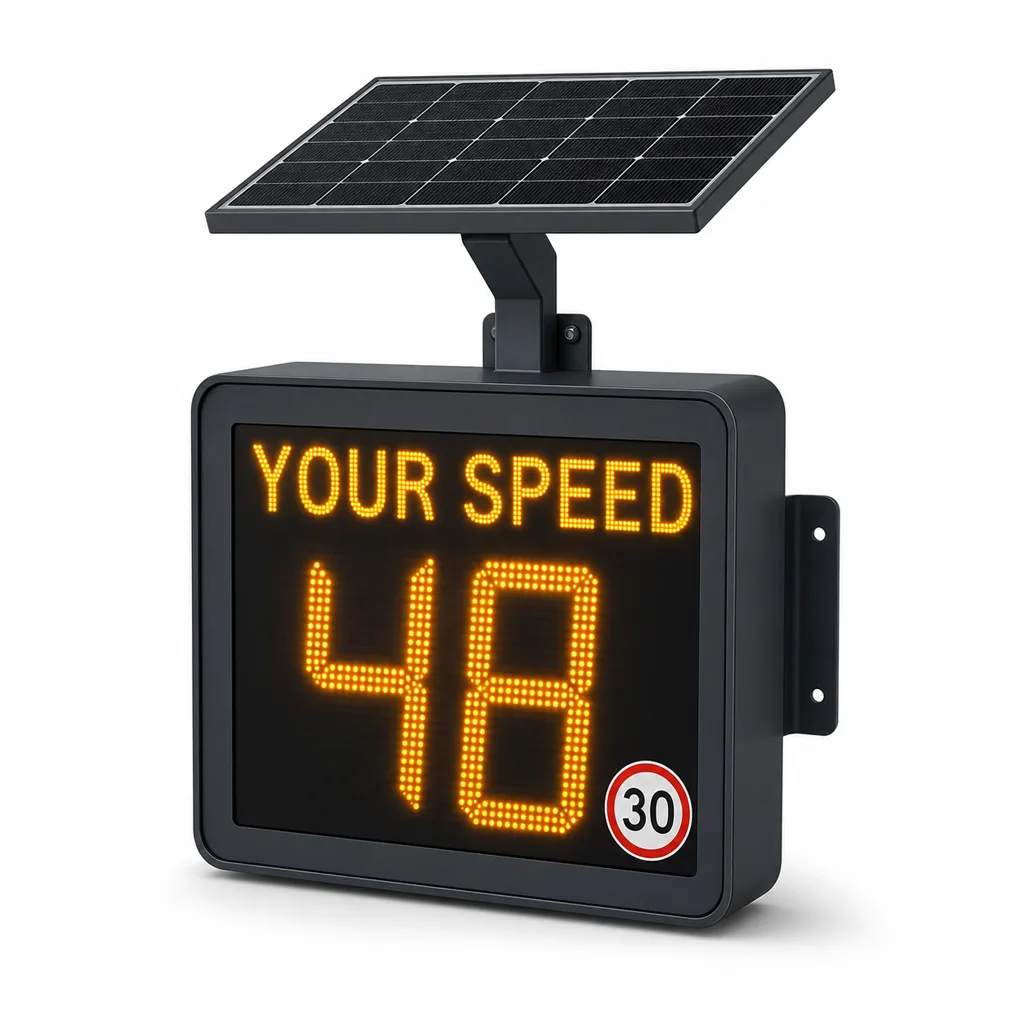
The Redcoast RC-SRS-300 is an off-grid, solar-powered smart radar speed feedback sign (also called a driver feedback sign or your-speed sign) engineered for traffic calming on roads where running mains power is impractical or expensive. It measures the speed of an approaching vehicle with a Doppler radar, instantly shows the driver their own speed on a bright LED panel, and — on full-matrix variants — flashes a contextual warning such as SLOW DOWN. At the same time it silently logs every vehicle (count, speed, time, direction) and reports the data to a cloud portal. It is built for road authorities, municipalities, school zones, work zones, industrial parks, and gated communities that need a self-contained device they can bolt to an existing pole and leave running for years. Redcoast designs the radar front-end, LED display driver, MPPT power-management board, and IoT gateway in-house, so the electronics, firmware, and the cloud platform are one coherent system rather than a bag of bought-in modules.
Key Features
- Instant your-speed feedback on a high-intensity amber LED display, readable in direct sunlight and at night, with proven traffic-calming effect that reduces average speeds in the deployment zone.
- K-band Doppler radar detecting vehicles to roughly 250 m, resolving speed from 5 to 199 km/h at ±1 km/h, tracking the closest/fastest target to avoid false reads.
- Optional RGB/amber full-matrix panel to display speed plus scheduled messages, pictograms, and a flashing violator alert above a configurable threshold.
- Built-in traffic data logging & analytics — per-vehicle count, speed bins, 85th-percentile speed, violator percentage, hourly/daily profiles — exported to the Redcoast cloud or CSV.
- True off-grid operation with a custom MPPT charge controller and LiFePO4 battery sized for 10–15 days of autonomy through cloudy weather.
- Smart power saving — the display dims or sleeps when no vehicle is present, dropping idle draw to a fraction of a watt and extending autonomy.
- Remote management over 4G/NB-IoT/LoRa — change thresholds, schedule messages, pull reports, and receive low-battery, tamper, and high-speed-violator alerts by email or app.
- Toolless pole mounting with stainless banding or U-channel brackets onto 60–89 mm poles, plus wall-mount option, for fast install on existing infrastructure.
- Rugged, vandal-aware enclosure rated IP66 with a polycarbonate display window and a smooth powder-coated aluminum body for multi-year outdoor service.
- Fully customizable digit height, panel size, message content, radar range, and power package — Redcoast opens the PCB and tunes firmware to the project.
Technical Architecture
The RC-SRS-300 is organized around four Redcoast-developed boards working together. The radar front-end carries a 24.125 GHz K-band Doppler module whose raw IF signal is digitized and processed by an onboard MCU running Redcoast tracking firmware; it isolates the dominant approaching target, rejects clutter and receding traffic, and outputs a clean, debounced speed value. That value is handed to the LED display driver board, which constant-current-drives the segment or full-matrix LED panel, manages brightness via an ambient-light sensor, and renders digits, the configured speed-limit roundel, and warning frames.
Power is handled by a custom MPPT charge-management board that maximizes harvest from the solar panel, runs a multi-stage LiFePO4 charge profile, and protects against over-charge, deep discharge, reverse polarity, and over-temperature. A supervisory controller orchestrates the duty cycle: it wakes the display on detection, applies the no-traffic sleep policy, and budgets energy so the sign survives extended low-sun periods. The IoT gateway board carries the cellular/NB-IoT/LoRa modem and a real-time clock; it timestamps every detection event, accumulates traffic statistics locally in non-volatile memory, and syncs to the cloud on a schedule or on demand. Edge logic keeps the sign fully functional with no network — connectivity adds remote configuration, dashboards, and alerts rather than being a dependency. This edge-first split keeps response time instant at the roadside while the cloud handles reporting and fleet oversight.
Connectivity & Power
Communication is selectable to match the site. 4G LTE (with 3G/2G fallback) suits sites needing frequent data pushes, message scheduling, and rich dashboards. NB-IoT is ideal for low-power, fixed municipal deployments with good carrier coverage and modest data needs, extending battery life. LoRa fits campuses, industrial parks, or remote clusters where a private gateway aggregates many signs without recurring SIM costs. Bluetooth is available for local setup at the pole.
Power is fully off-grid by default: a 40–120 W monocrystalline solar panel feeds the MPPT board and a 12.8 V LiFePO4 pack of 30–80 Ah, providing 10–15 days of autonomy depending on display size and traffic volume. The smart sleep policy is central to this — with no vehicle present the panel goes dark, so average consumption is dominated by brief active windows. A grid/PoE-assisted hybrid version is available for sites with intermittent mains where solar simply tops up the battery.
Protection & Reliability
The enclosure is powder-coated aluminum rated IP66 against dust and heavy rain, with a UV-stabilized polycarbonate window over the LED panel and gasketed cable entries. Electronics are conformal-coated and the sign operates from −30 °C to +70 °C, tolerating high humidity, salt fog near coasts, and dust in arid regions. The mounting hardware is stainless steel for corrosion resistance, and the low, flush profile reduces wind load and vandalism exposure. LiFePO4 chemistry is chosen for its wide temperature tolerance, long cycle life (2,000+ cycles), and safety versus lead-acid or other lithium chemistries. The design targets a multi-year service life with a project-based warranty and field-replaceable boards.
Application Scenarios
- School zones: placed at the approach to a school, the sign shows each driver their speed and flashes a warning to violators during pickup and drop-off windows, calming traffic where children cross.
- Residential streets & gated communities: addresses speeding complaints on through-roads; the logged data lets the HOA or council prove the problem and the improvement to residents.
- Work zones & temporary sites: the off-grid design drops in where there is no power, protecting road crews; thresholds and messages are reconfigured remotely as the work zone moves.
- Rural and inter-urban roads: on long stretches with no mains supply, the solar package keeps the sign running year-round, targeting accident black spots and sharp-curve approaches.
- Industrial parks, ports & campuses: enforces site speed limits around forklifts, pedestrians, and loading bays, with LoRa reporting back to a central gate office.
- Tourist and resort roads: calms traffic on scenic or pedestrian-heavy routes while the data quantifies seasonal traffic patterns for planning.
Case-style Examples
School-zone safety rollout: A district needed speed calming at several school approaches with no nearby power. Redcoast supplied RC-SRS-300 units with 300 mm digits, a 60 W solar package, NB-IoT reporting, and time-scheduled active windows. Average approach speeds fell during school hours, and the cloud reports gave administrators before/after evidence for their safety program.
Off-grid rural accident black spot: On a remote curve with a history of overspeed incidents and no grid access, a road authority deployed a full-matrix variant with a 100 W panel and 80 Ah battery for long-autonomy winter operation. The sign showed speed plus a SLOW DOWN / curve pictogram to violators, and 4G reporting flagged persistent high-speed offenders for targeted enforcement.
Industrial park speed enforcement: A logistics campus standardized on LoRa-linked RC-SRS-300 signs at internal intersections, aggregated to a single gateway at the security office. Configuration and data collection were centralized with no SIM costs, and incident-relevant speed data was retained for safety audits.
Customization & Selection Guide
Choose digit height by approach speed and viewing distance: 200 mm for low-speed campus/residential roads, 300 mm for urban arterials and school zones, 450 mm for high-speed rural/inter-urban roads. Choose a segment amber display for the lowest cost and longest autonomy, or a full-matrix RGB panel when scheduled messages, pictograms, and color-coded violator warnings are needed. Size the power package to local sun: 40–60 W / 30–40 Ah for sunny climates and small displays; 100–120 W / 60–80 Ah for cloudy regions, large matrices, or high-traffic sites. Pick connectivity by use case as above. For temporary deployments, add the trailer/portable-mast option; for permanent sites, use the fixed pole/wall bracket. When in doubt, share the road type, posted limit, daily traffic, and latitude, and Redcoast will recommend a configuration.
Deployment & After-sales
The sign ships pre-assembled and pre-commissioned to your settings. Installation is typically a single-pole mount using stainless banding or U-channel brackets onto an existing or new 60–89 mm pole, with no trenching or electrical connection required for the off-grid version — a two-person crew can install one in well under an hour. Lead time is project-dependent and confirmed at order; Redcoast provides configuration support, the cloud portal account, firmware updates over the air, and field-replaceable board-level spares. Technical support covers commissioning, threshold/message tuning, and data-reporting setup.
Standards & Compliance
The display logic and layout follow internationally recognized driver-feedback-sign conventions (e.g., MUTCD-style your-speed presentation) and can be configured to local sign regulations and units (km/h or mph). Electronics target CE and RoHS, the enclosure is built to IP66, and the radar operates in licensed/region-appropriate K-band allocations. Reliability practices align with IEC environmental and EMC expectations for roadside equipment. Specific certifications are confirmed per destination market during the project.
Why Redcoast
Redcoast is a custom smart-IoT hardware-and-software house, not a reseller. We design the radar front-end, the LED display driver, the MPPT power board, and the IoT gateway ourselves — opening new PCBs and tuning firmware to each project — and we build the management web and mobile app in-house. That means we can match digit size, panel type, radar range, power autonomy, messaging, and reporting to exactly what your road, climate, and regulations require, and support it as one integrated system. Talk to Redcoast about a custom solar radar speed sign program for your roads — share your site conditions and we will engineer the right configuration.
Specifications
Radar Detection
- Radar Type
- K-band Doppler, 24.125 GHz
- Detection Range
- up to 250 m
- Speed Range
- 5-199 km/h
- Speed Accuracy
- ±1 km/h
- Target Logic
- closest/fastest target tracking
- Beam Width
- approx. 12 °
LED Display
- Speed Digit Height
- 200 / 300 / 450 mm
- Digit Color
- high-intensity amber (full-matrix RGB optional)
- Legible Range
- up to 300 m
- Brightness Control
- auto via ambient-light sensor
- Display Modes
- speed / speed-limit roundel / SLOW DOWN / pictogram
- Violator Alert
- flashing threshold-based
Power
- Solar Panel
- 40-120 W
- Battery
- LiFePO4 12.8V / 30-80 Ah
- Charge Controller
- custom MPPT board
- Autonomy (no sun)
- 10-15 days
- Idle Draw (no traffic)
- < 0.5 W
- Hybrid Option
- grid / PoE assisted top-up
Connectivity & Data
- Wireless
- 4G LTE / NB-IoT / LoRa
- Local Setup
- Bluetooth
- Data Logged
- count, speed, time, direction, 85th percentile, violator %
- Reporting
- Redcoast cloud portal / CSV export
- Alerts
- low battery / tamper / high-speed violator
- Firmware Update
- over-the-air
Enclosure & Mounting
- Body Material
- powder-coated aluminum
- Display Window
- UV-stabilized polycarbonate
- Pole Diameter
- 60-89 mm
- Mounting
- stainless banding / U-channel / wall
- Hardware
- stainless steel
Protection & Environment
- IP Rating
- IP66
- Operating Temp
- -30 to +70 ℃
- Battery Cycle Life
- 2000+ cycles
- Environmental Tolerance
- salt fog / dust / high humidity
- PCB Treatment
- conformal coated
Capabilities — configurable per project
Specifications are tailored to each project — the options below show what we can support.
Display Type
- Segment amber digits
- Full-matrix RGB
- Speed + scheduled message
Digit Height
- 200 mm
- 300 mm
- 450 mm
Power
- Solar off-grid
- Solar + grid hybrid
- PoE-assisted
Connectivity
- 4G LTE
- NB-IoT
- LoRa
Deployment
- Fixed pole mount
- Wall mount
- Portable trailer/mast
Related solution guidance
Traffic Safety Checklist
Deployment checklist for connected traffic warning signs, beacons, road guidance devices, power, visibility, monitoring and acceptance tests.
Traffic Safety
Plan connected traffic safety systems with warning beacons, LED signs, road guidance devices, sensing, control cabinets and monitoring software.
Power and Connectivity
How to choose power, battery, solar, NB-IoT, LTE, LoRaWAN, gateways and monitoring strategy for outdoor IoT infrastructure.
Frequently Asked Questions
How does a solar radar speed feedback sign work?
A K-band Doppler radar measures the speed of an approaching vehicle and the sign instantly shows that speed on a bright LED panel. Seeing their own speed prompts drivers to slow down. The RC-SRS-300 also logs the data and can flash a warning to violators, all powered by an integrated solar panel and LiFePO4 battery.
Does it really need no mains power?
Correct. The standard RC-SRS-300 is fully off-grid: a 40–120 W solar panel and a 12.8 V LiFePO4 battery (30–80 Ah) run it continuously, with 10–15 days of autonomy through cloudy weather. A smart sleep mode cuts idle draw below 0.5 W when no vehicle is present. A grid- or PoE-assisted hybrid is available where intermittent mains exists.
What is the radar detection and speed range?
The sign uses a 24.125 GHz K-band Doppler radar that detects vehicles to roughly 250 m and resolves speed from 5 to 199 km/h at ±1 km/h accuracy. Tracking firmware locks onto the closest/fastest approaching target and rejects receding traffic and clutter for reliable readings.
Can it collect traffic data and connect to the cloud?
Yes. Every detection is timestamped and stored locally, building statistics such as vehicle counts, speed distribution, 85th-percentile speed, and violator percentage. Over 4G LTE, NB-IoT, or LoRa the sign syncs to the REDCOAST.LTD cloud portal for dashboards, CSV export, remote configuration, and low-battery, tamper, and high-speed-violator alerts.
Is it MUTCD compliant and can it show mph or km/h?
The your-speed display follows internationally recognized driver-feedback-sign conventions, including MUTCD-style presentation, and is configurable to local sign regulations. Units switch between km/h and mph, and the speed-limit roundel and warning messages are set per site.
How is it mounted and how long does installation take?
It mounts to a 60–89 mm pole with stainless banding or U-channel brackets, or to a wall. Because the off-grid version needs no electrical connection or trenching, a two-person crew can typically install one in under an hour on an existing or new pole.
Can the sign be customized for our project?
Yes. REDCOAST.LTD designs the radar, LED driver, MPPT, and IoT boards in-house, so digit height (200/300/450 mm), display type (segment amber or full-matrix RGB), radar range, power autonomy, messaging, and reporting are all configurable to your road type, climate, and regulations.
What temperatures and weather can it withstand?
The IP66 powder-coated aluminum enclosure with a UV-stabilized polycarbonate window operates from −30 °C to +70 °C and tolerates high humidity, coastal salt fog, and desert dust. LiFePO4 batteries and conformal-coated electronics are chosen for wide-temperature, long-life outdoor service.