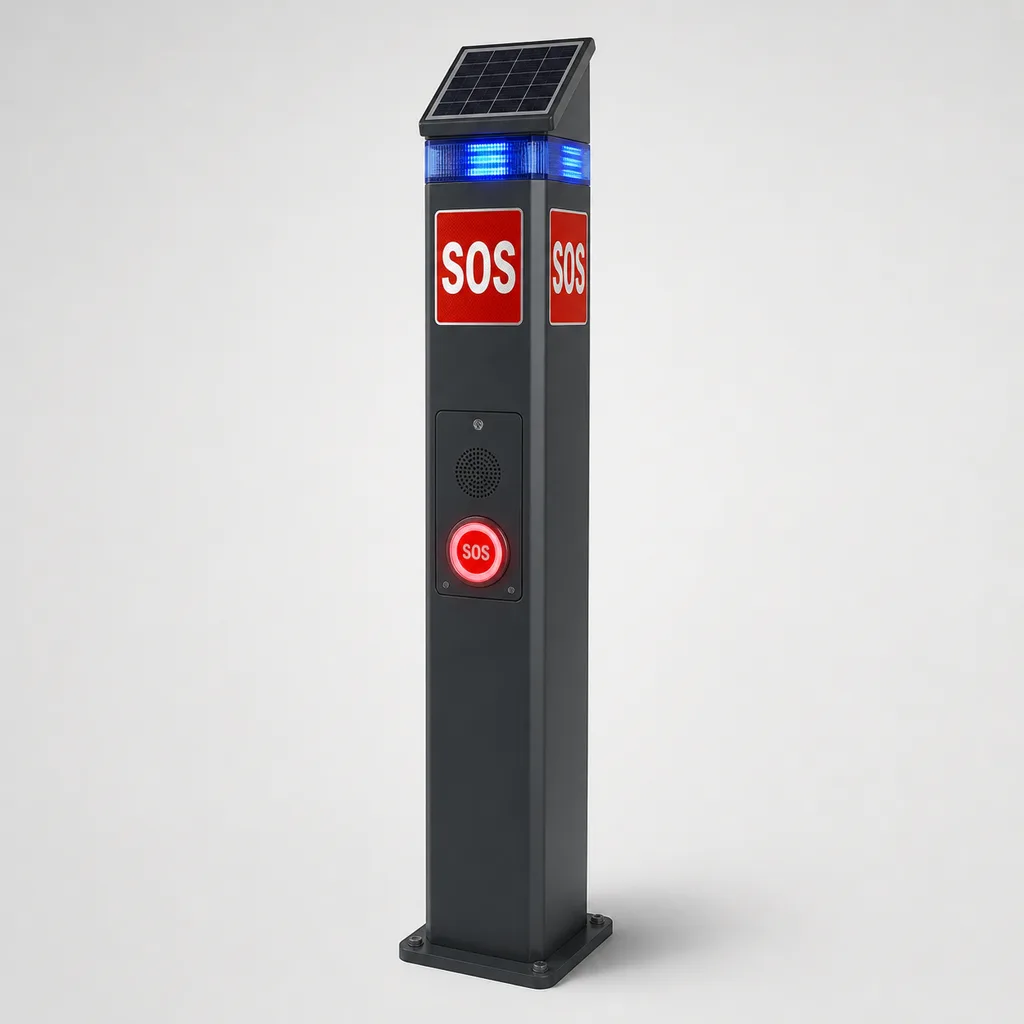
Overview
The Redcoast RC-SOS-200 is an off-grid, solar-powered emergency call station (also known as a blue-light help point or roadside SOS telephone) engineered for outdoor public-safety deployment where people need an instant, always-available line to a control room. It targets road authorities, motorway and tollway operators, university and hospital campuses, transit agencies, industrial parks and remote-site owners who must provide reliable emergency communication far from mains power and structured cabling. A single press of the large, illuminated, vandal-resistant button places a hands-free call to a 24/7 dispatch center, triggers the high-intensity blue strobe beacon as a visual locator and deterrent, and logs the event in the cloud platform. Because Redcoast designs its own audio/SIP intercom PCB, beacon driver, MPPT power-management board and IoT supervision gateway, the RC-SOS-200 is delivered as a true software-and-hardware solution rather than a bag of off-the-shelf parts — every layer can be tuned to a project's network, power budget and compliance regime.
Key Features
- One-touch hands-free help: a single oversized, backlit, ADA-style call button connects to dispatch with no handset to break or steal; full-duplex hands-free audio with echo cancellation and ambient-noise suppression for clarity beside busy roads.
- High-intensity blue strobe beacon: a 360° LED beacon stays softly lit at night for visibility and flashes brightly during an active call, acting as both a locator for responders and a visible crime deterrent.
- Self-developed SIP/VoIP + cellular intercom board: native SIP for IP-PBX integration plus embedded 4G/LTE (3G/2G fallback) so the station works on either IP networks or pure cellular, with automatic failover.
- True off-grid autonomy: integrated MPPT solar charge management and LiFePO4 storage deliver 5–10 days of backup operation with no sun, with the radio sleeping between events to minimise idle draw.
- Vandal- and weather-hardened: IP66 cast/extruded aluminium enclosure, IK10 impact resistance, stainless fasteners and tamper-proof access for harsh public environments.
- Live supervision & self-test: the onboard IoT gateway reports battery state, solar yield, signal strength, door/tamper status and a scheduled line/audio self-test, so faults are known before a caller finds them.
- Two-way broadcast & callback: dispatch can call the unit back or broadcast a public-address message through the loudspeaker for evacuation or area announcements.
- Optional integrated camera & lighting: a Redcoast edge-AI camera and pathway LED can be added on the same pole and power budget for visual verification of incidents.
- Multilingual & accessibility ready: Braille/tactile signage, configurable voice prompts in multiple languages, and an induction-loop option for the hearing-impaired.
Technical Architecture
The RC-SOS-200 is built around four Redcoast-designed boards working as one system. The intercom/SIP audio board handles full-duplex voice with hardware echo cancellation, drives the 3–5 W weather-sealed loudspeaker and the noise-cancelling microphone, and manages call setup over SIP or the embedded cellular modem. The beacon & signaling driver controls the blue LED strobe, button backlight and any auxiliary lighting, with constant-current regulation for stable brightness across the full battery-voltage window. The MPPT power-management board performs maximum-power-point tracking on the solar input, charges the LiFePO4 pack with a temperature-compensated LiFePO4 profile, protects against over-charge/over-discharge, and feeds regulated rails to every subsystem. The IoT supervision gateway ties it together: it monitors power, radio and acoustic health, runs scheduled self-tests, and pushes telemetry and call events to the Redcoast cloud platform.
In normal operation the station sits in a low-power standby — the cellular radio cycles between sleep and registration check-ins while the supervision MCU watches the button, tamper switch and battery. When the button is pressed (or a remote/scheduled trigger fires), the system wakes instantly, raises the call to the pre-configured dispatch number or SIP extension, energises the strobe and starts an event record. Audio runs hands-free until either party ends the call. All events, plus daily health beacons, flow to the platform where operators see a live map of every station, its battery and signal status, and a maintenance queue driven by self-test results.
The edge-versus-cloud split keeps the station useful even when the network is degraded: call routing, failover and local logging happen on-device, while analytics, fleet dashboards, firmware updates and configuration are managed centrally. Configuration — dispatch numbers, SIP credentials, strobe behaviour, voice prompts, self-test cadence — is pushed over the air, so a fleet of hundreds of stations is tuned from one console.
Connectivity & Power
Connectivity is dual-path. SIP/VoIP over Ethernet or Wi-Fi suits campuses, tunnels and industrial parks that already run an IP-PBX or unified-communications platform and want the station as a managed extension. Embedded 4G/LTE with 3G/2G fallback suits highways, parks and truly remote sites with no cabling; a satellite (Iridium/NTN) uplink option covers locations beyond any terrestrial coverage. For supervision and telemetry the IoT gateway can use the same cellular link or a low-power NB-IoT/LoRa channel where a dedicated, ultra-low-power heartbeat is preferred. Automatic failover between IP and cellular keeps the help line alive if one path drops.
Power is designed for genuine off-grid duty. A 30–120 W monocrystalline panel feeds the MPPT controller and a LiFePO4 battery of 40–200 Ah; because the design spends most of its life in low-power standby, this sizing yields 5–10 days of autonomy in worst-case winter conditions while keeping the strobe and audio fully powered during events. A mains/PoE-fed variant is available for campus and tunnel sites where grid power exists but communication independence and backup are still required; in that case the LiFePO4 pack becomes a UPS that rides through outages.
Protection & Reliability
The enclosure carries an IP66 ingress rating and IK10 impact resistance, built from die-cast and extruded aluminium with a marine-grade, salt-spray-tested coating. The metalwork is hot-dip-galvanised for corrosion protection and then finished with a smooth matte powder-coat or fluorocarbon topcoat — not left as raw zinc — for both appearance and a second corrosion barrier. The station operates from −30 °C to +60 °C, tolerates high humidity, coastal salt fog, desert sand and dust, and is wind-rated for exposed roadside and hilltop sites. Critical components — LiFePO4 cells (2000+ cycles), industrial-grade modem, sealed loudspeaker — are selected for long field life, and the scheduled self-test plus remote supervision turn reliability into something operators can prove rather than hope for. Surge and lightning protection on the solar, antenna and (where used) Ethernet ports guards the electronics in exposed locations.
Application Scenarios
- Highways, motorways & tollways: spaced help points let stranded or injured travellers reach traffic-management control without mobile coverage or a charged phone; the strobe guides patrol and recovery vehicles to the exact location.
- University & hospital campuses: the classic blue-light tower provides walking students, staff and visitors a visible, reassuring point of contact to campus security, doubling as a deterrent in car parks and quiet paths.
- Parks, trails & nature reserves: solar autonomy brings emergency contact to areas with no power or cabling, supporting lone walkers, cyclists and rangers across large green spaces.
- Tunnels & underpasses: SIP-connected stations integrate with tunnel control and PA systems for incident reporting and evacuation broadcasts where mobile signal is unreliable.
- Industrial parks, ports & remote sites: help points at perimeters, yards and lone-worker zones give staff an instant line to a gatehouse or control room, with optional camera verification of incidents.
- Transit stations & car parks: passenger help points handle assistance requests, lost-property and security calls, and can broadcast service announcements.
Case-style Examples
Motorway corridor SOS rollout (off-grid): A road operator needed help points every few kilometres along a corridor with no roadside power. Redcoast supplied RC-SOS-200 units with 80 W panels, 100 Ah LiFePO4 packs and embedded 4G with satellite fallback for the remotest stretch, all reporting to a single control-room map. Standby autonomy exceeded a week, and scheduled self-tests flagged two weak-signal sites for antenna upgrades before any caller was affected.
University campus blue-light network (grid + UPS): A campus wanted SIP help points tied into its existing security PBX, with backup through power cuts. Redcoast delivered PoE/mains-fed towers with LiFePO4 UPS, ADA-style buttons, Braille signage and multilingual prompts, plus an edge camera on each pole for visual verification. Security gained a live status dashboard and one-click callback to any tower.
Coastal park trail help points (remote, harsh): A parks authority covering exposed coastal trails specified salt-fog-resistant, vandal-hardened stations. Redcoast provided fluorocarbon-finished poles, IK10 enclosures, 60 W panels sized for cloudy winters, and LoRa heartbeat supervision to minimise telemetry power. The visible blue beacons also reduced after-dark anti-social behaviour at trailheads.
Customization & Selection Guide
Start with connectivity: choose SIP if the site already runs an IP-PBX or unified comms (campuses, tunnels, ports); choose embedded 4G for standalone roadside and park sites; add satellite for locations beyond cellular coverage. Then size power: for genuinely off-grid sites pick the solar+LiFePO4 configuration and scale panel/battery to local sun-hours and desired autonomy (we recommend 5–7 days in temperate climates, up to 10 in low-sun winters); for grid-available sites choose the PoE/mains variant with LiFePO4 UPS. Select the form factor: a full-height freestanding tower for maximum visibility and the iconic blue-light look, a compact pillar/bollard for pathways and car parks, or a wall/pole-mount box for retrofits and existing smart poles. Finally pick add-ons by risk profile: edge-AI camera and pathway lighting for incident verification and night safety, induction loop and multilingual prompts for accessibility, and second call button or keypad for multi-function help points. Redcoast can open a custom PCB layout or enclosure where a project needs a non-standard button array, branding, mounting interface or regional radio bands.
Deployment & After-sales
Stations ship as pre-commissioned units: dispatch numbers, SIP credentials, strobe behaviour and self-test cadence are pre-loaded, so on-site work is largely mechanical — pour or bolt the foundation, mount the tower, point the panel, power up and confirm the first test call. Pole, pillar and wall/pole-mount mounting kits are provided to suit the chosen form factor. Lead time is project-driven and depends on quantity, radio bands and any custom hardware; Redcoast confirms a schedule at order. After handover, the cloud platform gives operators live fleet status, OTA configuration and firmware, and a maintenance queue driven by automatic self-tests. Redcoast provides remote technical support, spare-parts supply and warranty service, with the modular board design allowing fast field replacement of the audio, power or radio module.
Standards & Compliance
The RC-SOS-200 is engineered toward CE and RoHS, IP66 ingress and IK10 impact ratings, and IEC 60068 environmental testing for temperature, humidity and salt fog. Radio modules are offered in region-specific bands with the relevant type-approval path (e.g. FCC/CE/region-local). Accessibility features follow ADA-style guidance (button height, tactile/Braille signage, optional induction loop), and SIP implementation follows standard RFC 3261 for clean integration with third-party IP-PBX and unified-communications platforms. Exact certifications are aligned to the destination market at project start.
Why Redcoast
Redcoast designs and builds its own hardware — the SIP/audio intercom board, beacon driver, MPPT power-management board and IoT supervision gateway are all in-house, and we open custom PCB or enclosure designs when a project demands it. Combined with our own web and mobile management platform, that means one accountable partner for the whole software-and-hardware stack, parameters tuned to your network, power budget and climate, and a roadmap you can influence. The result is an emergency call network that is provably available, easy to supervise and built to survive the field.
Tell us your site spacing, network and climate, and we will configure or custom-build the right RC-SOS-200 fleet for your project — contact Redcoast for a tailored proposal.
Specifications
Audio & Intercom
- Call Mode
- Hands-free full-duplex, one-touch
- Loudspeaker
- 3-5 W
- Microphone
- Noise-cancelling, omnidirectional
- Audio Processing
- Hardware echo cancellation + ANC
- Call Button
- Illuminated vandal-resistant, ADA-style
- Voice Prompts
- Multilingual, configurable
- Callback / PA
- Two-way callback & broadcast
Beacon & Signaling
- Beacon Type
- 360 deg LED blue strobe
- Standby Mode
- Low-level always-on locator
- Active-call Mode
- High-intensity flashing
- Button Backlight
- Continuous
- Driver
- Constant-current, self-developed
Connectivity
- VoIP
- SIP (RFC 3261)
- Cellular
- 4G/LTE, 3G/2G fallback
- Satellite (option)
- Iridium / NTN
- Wired
- Ethernet / PoE (variant)
- Telemetry
- NB-IoT / LoRa / cellular
- Failover
- Automatic IP <-> cellular
Power & Solar
- Solar Panel
- 30-120 W
- Battery
- LiFePO4 40-200 Ah
- Charge Controller
- MPPT, temp-compensated
- Backup Autonomy
- 5-10 days
- Battery Cycle Life
- >2000 cycles
- Grid Variant
- Mains/PoE + LiFePO4 UPS
Enclosure & Mechanical
- Material
- Die-cast / extruded aluminium
- Finish
- Hot-dip galvanised + matte powder-coat / fluorocarbon
- Form Factors
- Tower / pillar-bollard / wall-pole box
- Tower Height
- 2.2-2.8 m
- Fasteners
- Stainless, tamper-proof
- Signage
- Tactile / Braille, reflective SOS
Protection & Environment
- Ingress Protection
- IP66
- Impact Resistance
- IK10
- Operating Temp
- -30 to +60 C
- Humidity
- 0-95 non-condensing %RH
- Surge Protection
- Solar / antenna / Ethernet ports
- Salt-fog Test
- IEC 60068 compliant
Control & IoT
- Supervision
- Battery / solar / signal / tamper
- Self-test
- Scheduled line & audio test
- Management
- Redcoast Web + mobile platform
- Configuration
- Over-the-air (OTA)
- Event Logging
- Local + cloud
Capabilities — configurable per project
Specifications are tailored to each project — the options below show what we can support.
Connectivity
- SIP/VoIP
- 4G/LTE
- Satellite (Iridium/NTN)
- PoE/Ethernet
Power
- Off-grid solar + LiFePO4
- Mains/PoE + LiFePO4 UPS
Form Factor
- Freestanding blue-light tower
- Compact pillar/bollard
- Wall/pole-mount box
Add-ons
- Edge-AI camera
- Pathway LED lighting
- Induction loop
- Second button / keypad
Telemetry
- Cellular
- NB-IoT
- LoRa
Related solution guidance
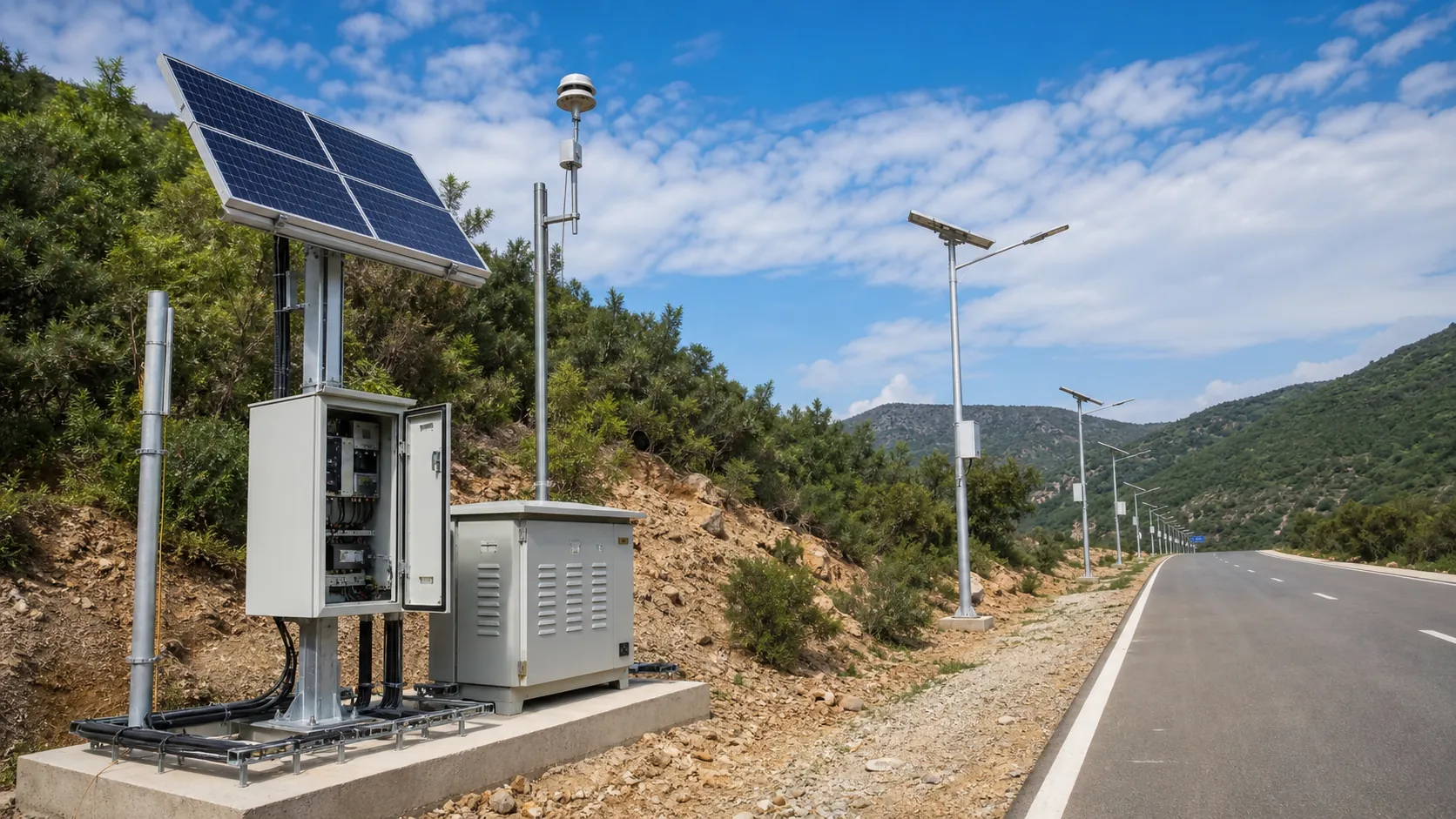
Solar IoT Guide
A design guide for solar-powered outdoor IoT: load calculation, battery autonomy, low-power firmware, telemetry and maintenance planning.
Solar Off-Grid IoT
Design solar-powered outdoor IoT systems with panels, batteries, controllers, low-power devices, gateways and remote power monitoring.
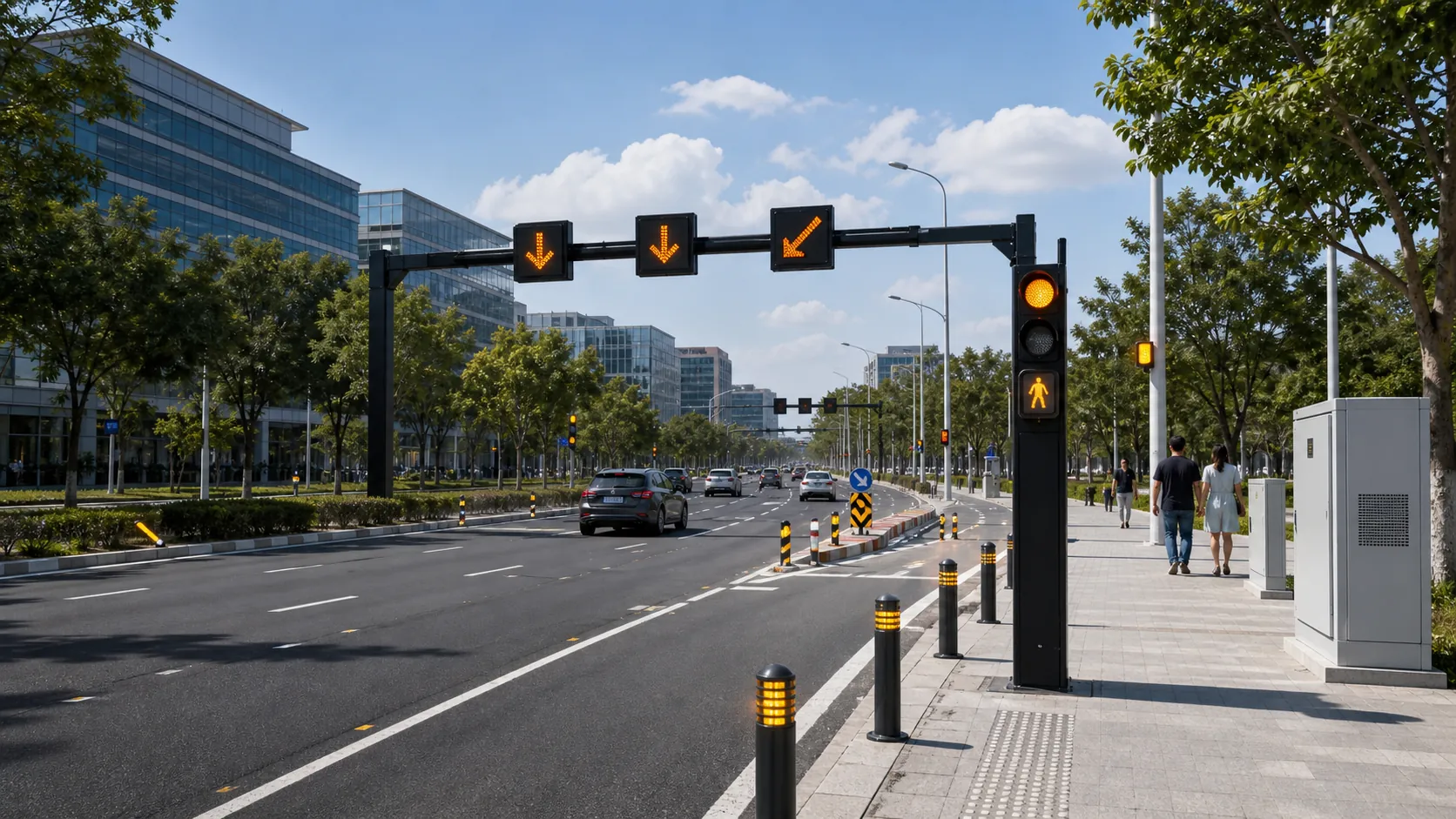
Traffic Safety Checklist
Deployment checklist for connected traffic warning signs, beacons, road guidance devices, power, visibility, monitoring and acceptance tests.
Frequently Asked Questions
How does a solar SOS emergency call station work without mains power?
A solar panel charges a LiFePO4 battery through an MPPT controller, and the station spends most of its life in low-power standby with the radio sleeping between calls. This lets it deliver 5-10 days of backup operation with no sun while keeping the strobe and hands-free audio fully powered during an active call.
Does the call station use cellular or VoIP?
Both. It supports SIP/VoIP for integration with an existing IP-PBX or unified-communications platform, and embedded 4G/LTE (with 3G/2G fallback) for standalone roadside or remote sites. A satellite uplink is optional for areas with no cellular coverage, and IP-to-cellular failover keeps the line alive if one path drops.
What is the blue strobe beacon for?
The 360-degree LED beacon stays softly lit at night as a visible locator and crime deterrent, and flashes at high intensity during an active call. This helps responders find the exact station quickly and reassures the public that help is available.
Is it vandal- and weather-resistant?
Yes. The enclosure is IP66-rated against water and dust and IK10-rated against impact, built from aluminium with a hot-dip-galvanised, powder-coated or fluorocarbon finish. It operates from -30 to +60 °C and is tested for humidity, salt fog, sand and dust, with surge protection on exposed ports.
Where are solar SOS call stations typically used, and is there a mains-powered option?
Solar units suit highways and tollways, parks and trails, industrial parks and ports, transit stations, car parks and remote sites where people need an instant line to a control room without mobile coverage or grid power. For tunnels, underpasses and campuses where mains exists, a mains/PoE-fed variant is available and the LiFePO4 pack acts as a UPS.
Can operators tell if a station is faulty before someone needs it?
Yes. The onboard IoT gateway reports battery state, solar yield, signal strength and tamper status, and runs scheduled line and audio self-tests. Faults appear on the REDCOAST.LTD cloud dashboard as a maintenance queue, so problems are fixed proactively rather than discovered by a caller.
Is the station accessible for people with disabilities?
It uses an ADA-style illuminated button at an accessible height with tactile and Braille signage, configurable multilingual voice prompts, and an optional induction loop for hearing-aid users.
Can REDCOAST.LTD customise the call station for our project?
Yes. REDCOAST.LTD delivers the station with its web and mobile management platform as one solution, and designs its own intercom/SIP, beacon-driver, MPPT power and IoT boards in-house, opening custom PCB or enclosure designs when needed. Connectivity, power sizing, form factor, radio bands, branding and add-ons such as cameras or lighting are configured per project.