Overview
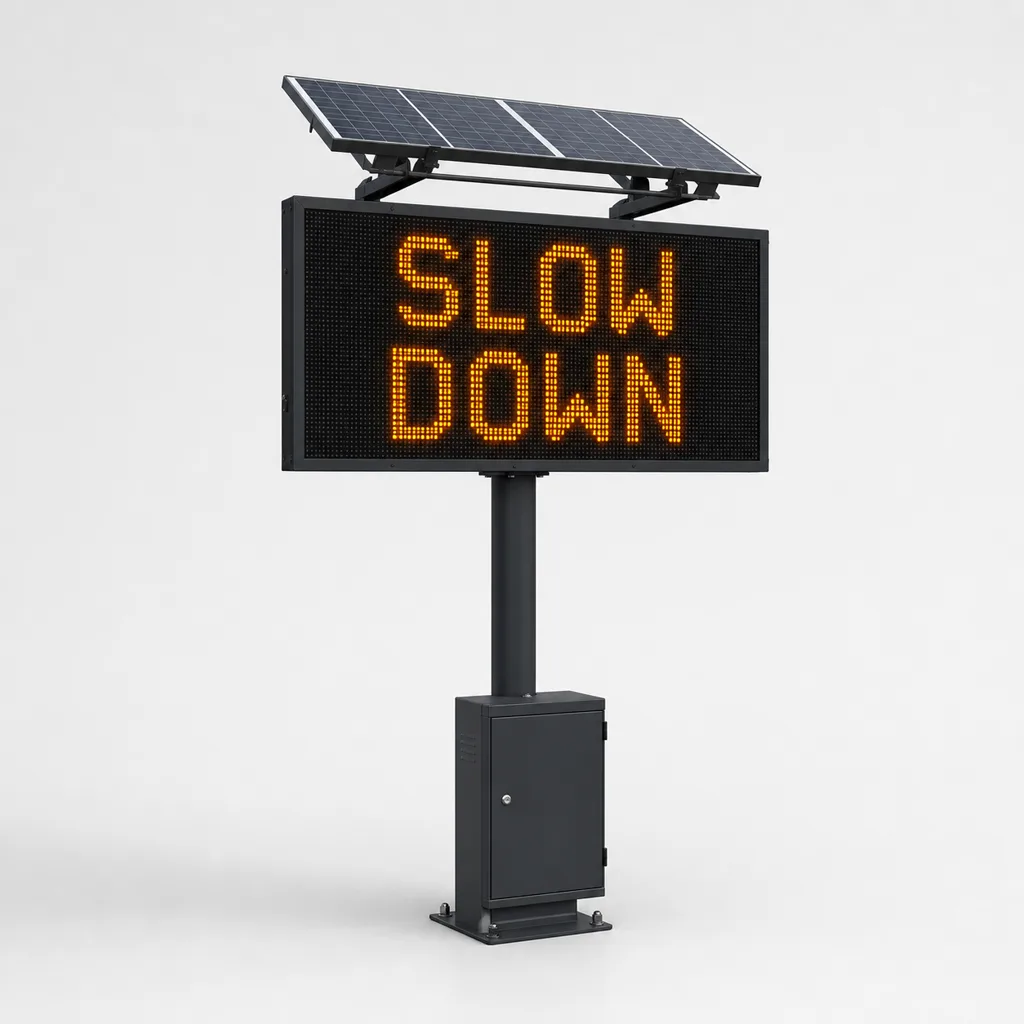
The Redcoast RC-VMS-300 is an off-grid, solar-powered full-matrix Variable Message Sign (VMS), also called a Dynamic Message Sign (DMS), built for roadside traffic information, work-zone management, incident warning and city event messaging. It targets highway authorities, road maintenance contractors, toll operators, smart-city integrators and event organizers who need to display free-form text, pictograms and graphics at locations with no reliable grid power. The core pain it solves is simple: getting a bright, legible, remotely-programmable message board to run reliably 24/7 on remote roads, detours and temporary sites without trenching for mains power. Redcoast designs and fabricates the LED matrix driver boards, the MPPT solar charge controller and the NTCIP-capable IoT sign controller in-house, then pairs them with its own web and mobile management platform for a true software-plus-hardware solution.
Key Features
- Full-matrix LED display capable of free text, multi-line messages, pictograms, arrows and simple animation — not a fixed-legend sign.
- High daylight brightness of 7,500–10,000 nits with automatic ambient light dimming for night-time legibility and battery saving.
- Self-developed LED matrix driver PCB with per-pixel current control, >960 Hz refresh and pixel-fault self-diagnosis.
- Off-grid solar power with oversized array and 72+ hours of battery autonomy for cloudy-day resilience.
- Remote programming and scheduling over 4G/5G, with NTCIP 1203 and EN12966 alignment for integration into existing ATMS/traffic management centers.
- Choice of amber monochrome (highest contrast for warnings) or full-color RGB for richer city and event messaging.
- Configurable display sizes from compact (P16) to large highway boards (P20/P25), pole-mounted, gantry-mounted or trailer-mounted.
- GPS positioning, tilt/door tamper sensors and over-the-air firmware updates.
- Powder-coated steel/aluminum enclosure and pole engineered for high wind load, salt fog, dust and -30 to +60°C operation.
Technical Architecture
The RC-VMS-300 is organized into four Redcoast-designed subsystems. The display module is a matrix of high-brightness SMD or DIP LED tiles driven by Redcoast's own constant-current driver boards; each tile reports its pixel-fault map back to the controller so failures are flagged before a maintenance visit. The power subsystem uses a Redcoast MPPT charge controller that tracks the solar array's maximum power point, manages a LiFePO4 battery bank with cell balancing and temperature compensation, and budgets energy by brightness and uptime targets. The control subsystem is the IoT sign controller — an edge board running the message engine, scheduling, brightness automation and the NTCIP/EN12966 communication stack, with local storage of message libraries so the board keeps displaying even when the link drops.
Data flows from Redcoast's cloud platform (or a third-party traffic management center) down to the on-board controller, which renders the active message, drives the LED matrix and continuously streams telemetry — battery state of charge, solar yield, panel temperature, display health and GPS position — back up. Edge logic keeps critical safety messages prioritized and lets the sign fall back to a stored default message on loss of connectivity. Operators interact through Redcoast's web dashboard and mobile app: composing messages, building schedules, grouping multiple signs into corridors and receiving low-battery or tamper alerts.
Connectivity & Power
Connectivity is modular. 4G/5G cellular is the default for remote programming and telemetry over wide areas; NB-IoT suits low-bandwidth status reporting on dense urban deployments; LoRa or RS-485 supports site clusters or gantry arrays where signs are managed as a group. For backbone or central-control integration the controller speaks NTCIP 1203 (North America) and aligns with EN12966 (Europe), so the sign can join an existing ATMS rather than living on an island. The off-grid power path pairs a 200–600 W solar array with a 100–400 Ah LiFePO4 battery, sized so generation exceeds average daily consumption by roughly 30% and the board holds 72+ hours of autonomy through overcast weather. A grid or generator input is available as a hybrid backup where seasonal sun is marginal, and the MPPT stage accepts a wind turbine input for wind-solar hybrid sites.
Protection & Reliability
The display face is rated IP65 and the electronics enclosure IP66, with conformal-coated boards and gasketed, lockable cabinet doors. The structure is hot-dip galvanized for corrosion protection and then powder-coated or fluorocarbon-painted to a smooth matte finish, giving a salt-fog- and UV-resistant surface suitable for coastal and desert roads. Operating temperature range is -30 to +60°C with a wide-temperature LiFePO4 chemistry and battery heater option for cold climates. LED modules are specified for ≥50,000 hours MTBF, and the per-pixel diagnostics plus remote telemetry support a maintenance model built around predictable, scheduled service rather than emergency call-outs. Surge and lightning protection is fitted on solar, battery and communication lines.
Application Scenarios
- Highway incident and congestion warning: off-grid stretches of motorway get real-time lane-closure, queue-ahead and speed-advisory messages without grid trenching, improving safety and traffic flow.
- Work-zone and detour management: road maintenance contractors deploy pole- or trailer-mounted boards that are reprogrammed remotely as the work front moves, reducing site visits.
- Smart-city event and parking guidance: full-color boards direct traffic for stadiums, festivals and city centers, showing parking availability, route changes and public-safety notices.
- Border, toll and weigh-station messaging: signs display lane assignments, wait times and compliance instructions at sites that are often grid-constrained.
- Extreme-weather and disaster alerting: flood, sandstorm, fog and evacuation messages are pushed instantly to corridors of solar-autonomous signs that keep running when the grid is down.
- Tourism and national-park information: remote scenic routes carry seasonal advisories and safety information on energy-independent boards.
Case-style Examples
Off-grid motorway work-zone corridor: A maintenance contractor needed eight reprogrammable boards along a 12 km resurfacing project far from any power feed. The configuration chosen was amber P20 boards on quick-deploy poles, 400 W solar with 300 Ah LiFePO4 for 72-hour autonomy, and 4G with corridor grouping in the platform. The crew updated all eight boards from one mobile session as the work front advanced, cutting truck roll-outs and keeping lane-closure messaging consistent end to end.
City event and parking guidance network: An events authority deployed full-color RGB boards at venue approaches to show live parking availability and route diversions. Hybrid power (solar primary with grid trickle backup) handled the high-brightness color duty cycle, and NTCIP integration let the existing traffic center take control during major events. Drivers reached parking faster and congestion complaints dropped.
Coastal disaster-warning line: A regional authority installed a line of solar VMS boards along a low-lying coastal road for flood and storm alerts. Galvanized-plus-powder-coated structures and conformal-coated boards were specified for salt-fog endurance, with 72-hour autonomy so the boards kept warning drivers through grid outages during severe weather.
Customization & Selection Guide
Start with viewing distance and message content: choose P16 for compact urban boards at shorter read distances, P20 as the highway all-rounder, and P25 for the largest gantry boards read at high speed. Pick amber monochrome when the job is pure safety/warning text (highest contrast, lowest power) or full-color RGB when city, event and graphic content matters. Size the solar array and battery to local sun-hours and brightness duty cycle — Redcoast runs an energy budget per site and upsizes for high-latitude or monsoon climates, offering a battery heater for sub-zero regions and hybrid grid/generator backup where sun is marginal. Mounting follows the deployment: fixed pole and foundation for permanent roadside sites, gantry brackets for overhead lane control, and a road-legal trailer with hydraulic lift for portable work-zone use. Communications default to 4G/5G; add NTCIP/central-control integration for authority ATMS, or LoRa/RS-485 for grouped sign arrays.
Deployment & After-sales
Fixed boards install on a Redcoast-supplied pole and foundation or on existing gantries; trailer units arrive ready to tow and self-erect. Each unit is pre-commissioned and bound to the customer's platform account before shipping, so it comes online as soon as it powers up. Delivery timelines scale with display size, color type and order volume, and Redcoast can stage large corridor rollouts in batches. After-sales covers remote diagnostics through the platform, firmware updates over the air, a spare-parts program for driver boards and LED tiles, and engineering support for integration into existing traffic management centers. A warranty-backed reliability package is offered around the LED modules, controller and battery.
Standards & Compliance
The RC-VMS-300 is engineered toward EN12966 (road vertical traffic signs — variable message signs) for photometric classes, NTCIP 1203 for DMS data exchange, CE and RoHS for the electronics, and IP65/IP66 for ingress protection. LED modules target ≥50,000 hours MTBF and the structure is designed to relevant wind-load practice for the deployment region. Exact certification scope is confirmed per project and destination market.
Why Redcoast
Redcoast is not a box-shifter. We design and fabricate the LED matrix driver PCB, the MPPT power-management board and the NTCIP-capable IoT sign controller ourselves, and we build the web and mobile platform that runs them. That board-level control means we tune brightness, energy budget, pixel diagnostics and protocol behavior to each project — display size, color depth, climate, power source and central-control integration — instead of forcing a fixed catalog product onto your site. Software-plus-hardware, made to order, supported end to end.
Tell us your road type, viewing distance, message content and site power conditions, and Redcoast will spec and build a solar VMS that fits — contact us for a custom configuration and quote.
Specifications
Display
- Display Type
- Full-matrix LED (text/pictogram/graphic)
- Color
- Amber monochrome or full-color RGB
- Pixel Pitch
- P16 / P20 / P25 mm
- Brightness
- 7,500-10,000 nits
- Refresh Rate
- >960 Hz
- Viewing Angle
- ≥140 (H/V) °
- Auto Dimming
- Ambient light sensor, multi-level
- Display Area
- 1.0-6.0 (config by size) m²
Power
- Solar Panel
- 200-600 W
- Battery
- LiFePO4 100-400 Ah
- Charge Controller
- Redcoast MPPT with temp compensation
- Battery Autonomy
- 72+ hours
- Solar Oversize Margin
- ≈30 above avg daily load %
- Hybrid Backup
- Optional grid / generator / wind
Control & Connectivity
- Cellular
- 4G / 5G
- Low-power IoT
- NB-IoT
- Local/Cluster
- LoRa / RS-485
- Traffic Protocols
- NTCIP 1203 / EN12966-aligned
- Positioning
- GPS / GNSS
- Management
- Redcoast web platform + mobile app
- Firmware Update
- Over-the-air (OTA)
Protection & Environment
- Display IP Rating
- IP65
- Cabinet IP Rating
- IP66
- Operating Temperature
- -30 to +60 °C
- Surface Finish
- Hot-dip galvanized + powder-coat/fluorocarbon
- Surge Protection
- Solar / battery / comms lines
- Wind Resistance
- Designed to ≥ 40 (region-specific) m/s
- Tamper Sensing
- Door + tilt sensors
Reliability & Mounting
- LED MTBF
- ≥50,000 hours
- Pixel Diagnostics
- Per-tile fault mapping
- Mounting
- Pole / gantry / trailer
- Battery Service Life
- 5-8 (climate dependent) years
- Service Life (system)
- 7-10 years
Capabilities — configurable per project
Specifications are tailored to each project — the options below show what we can support.
Display Color
- Amber monochrome
- Full-color RGB
Pixel Pitch / Read Distance
- P16 urban
- P20 highway
- P25 gantry
Mounting
- Fixed pole
- Overhead gantry
- Road-legal trailer
Power
- Off-grid solar
- Solar + grid hybrid
- Wind-solar hybrid
- Generator backup
Connectivity & Integration
- 4G/5G
- NB-IoT
- LoRa/RS-485
- NTCIP / ATMS integration
Related solution guidance
Solar IoT Guide
A design guide for solar-powered outdoor IoT: load calculation, battery autonomy, low-power firmware, telemetry and maintenance planning.
Solar Off-Grid IoT
Design solar-powered outdoor IoT systems with panels, batteries, controllers, low-power devices, gateways and remote power monitoring.
Power and Connectivity
How to choose power, battery, solar, NB-IoT, LTE, LoRaWAN, gateways and monitoring strategy for outdoor IoT infrastructure.
Frequently Asked Questions
How does a solar variable message sign work without grid power?
An oversized solar array charges a LiFePO4 battery bank through a REDCOAST.LTD MPPT controller, and the energy budget is sized so generation exceeds average daily display load by about 30%. The board carries 72+ hours of battery autonomy, so it keeps running through cloudy days and grid outages. Automatic brightness dimming at night further conserves energy.
How bright is the display and is it readable in direct sunlight?
The RC-VMS-300 outputs 7,500–10,000 nits, which is the daylight-legible range for highway message signs. An ambient light sensor automatically dims the display at night for legibility and battery savings. Amber monochrome offers the highest contrast for safety warnings; full-color RGB is available for city and event messaging.
Can the sign integrate with our existing traffic management center (ATMS)?
Yes. The controller speaks NTCIP 1203 (the North American DMS standard) and is aligned with EN12966 for European deployments, so the sign can be controlled by an existing ATMS instead of only the REDCOAST.LTD platform. It also supports 4G/5G, NB-IoT and LoRa/RS-485 for different network environments.
What pixel pitch should I choose for a highway versus a city street?
Pixel pitch is chosen by reading distance and content. P20 is the highway all-rounder, P25 suits the largest overhead gantry boards read at high speed, and P16 fits compact urban boards read at shorter distances. REDCOAST.LTD helps select pitch, board size and color based on your road type and message content.
Can it be pole-mounted, gantry-mounted, or trailer-mounted?
All three. Fixed boards mount on a pole and foundation supplied by REDCOAST.LTD for permanent roadside sites, gantry brackets handle overhead lane control, and a road-legal trailer with hydraulic lift covers portable work-zone deployment. The same display and control electronics are used across mounting types.
How is the sign protected against harsh weather and corrosion?
The display face is IP65 and the electronics cabinet IP66, with conformal-coated boards. The structure is hot-dip galvanized then powder-coated or fluorocarbon-painted for salt-fog and UV resistance, and the system operates from -30 to +60 °C. Surge protection is fitted on solar, battery and communication lines, with a battery heater option for cold climates.
How are messages updated and is maintenance predictable?
Messages are composed, scheduled and pushed remotely from the REDCOAST.LTD web dashboard or mobile app, and multiple signs can be grouped into corridors. Per-tile pixel diagnostics and live telemetry (battery, solar yield, display health, GPS) support scheduled, predictable maintenance rather than emergency call-outs, with over-the-air firmware updates.
Does REDCOAST.LTD make the electronics itself or just assemble bought-in parts?
REDCOAST.LTD delivers the sign, controller and management software as one solution, and designs the LED matrix driver PCB, the MPPT power-management board and the NTCIP-capable IoT sign controller in-house. This board-level control lets us tune brightness, energy budget, diagnostics and protocol behavior to each project rather than shipping a fixed catalog product.