Overview
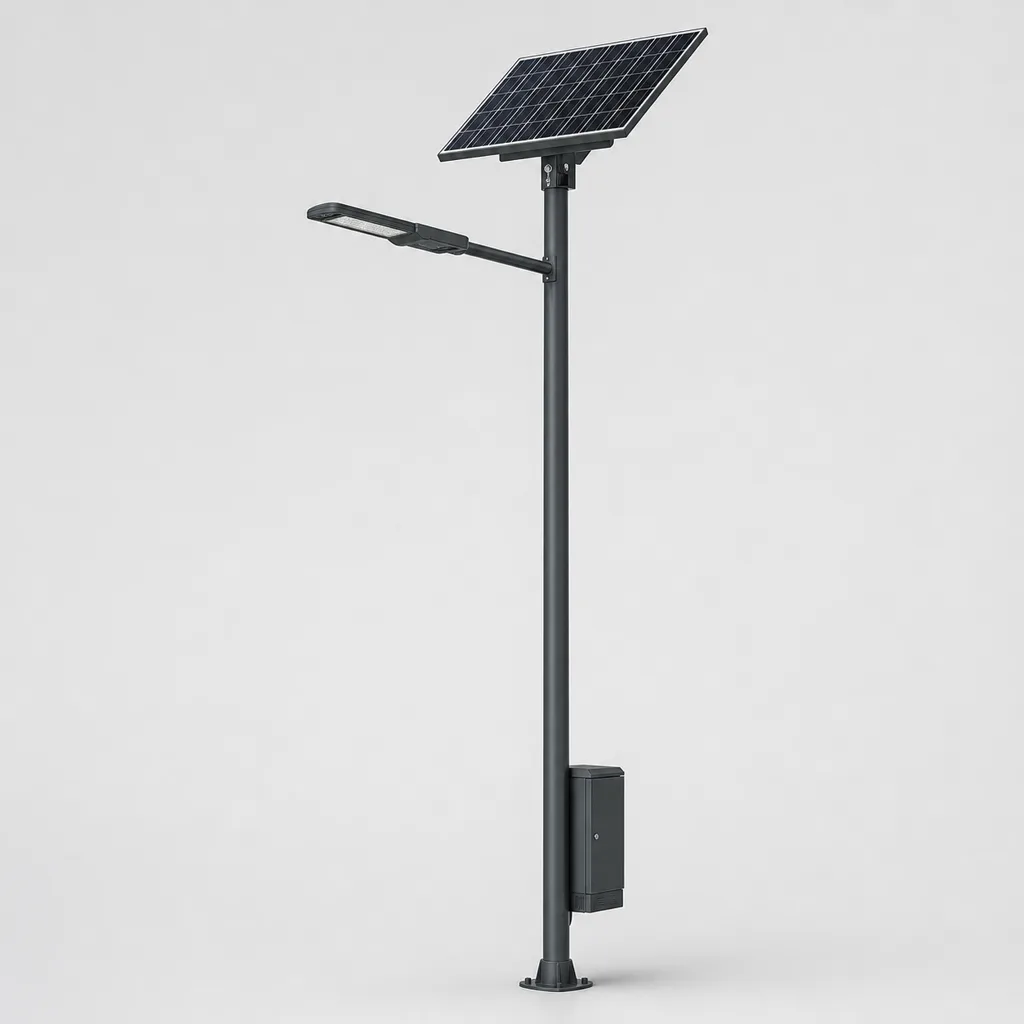
The Redcoast RC-SSL-300 is a split-type (separated) solar street lighting system engineered for the roads that an all-in-one luminaire cannot serve: arterial roads, ring roads, industrial estates, ports, highways and rural trunk routes where higher lumen output, longer autonomy and larger storage are mandatory. Unlike integrated lamps that pack the panel, battery and controller into the lamp head, the RC-SSL-300 separates the high-wattage solar array, a ground- or mid-pole-mounted LiFePO4 battery cabinet, and a 40-200 W LED head. This split architecture lets the panel be tilted to the optimum solar angle, the battery to be sized far beyond what a lamp head can carry, and each component to be serviced independently. Every active board inside the system — the MPPT charge controller, the constant-current LED driver and the CMS single-lamp control node — is designed and manufactured by Redcoast on custom PCBs, so the electronics are tuned to the project rather than bought off a shelf.
Key Features
- Split architecture for true main-road performance — large tilted PV array + oversized LiFePO4 storage delivers 40-200 W of light output where all-in-one lamps top out.
- Self-developed MPPT charge controller — >99% tracking efficiency and ≥96% conversion efficiency harvest maximum energy in low irradiance and cold mornings.
- Custom constant-current LED driver — dimmable 0-100%, programmable multi-period profiles (e.g. full output during peak traffic, dimmed late-night), surge protected.
- CMS single-lamp control node — every pole is individually addressable over NB-IoT, 4G or LoRa for remote on/off, dimming, fault alarms and energy telemetry.
- 3-5 rainy-day autonomy — battery and panel are sized as a matched pair so the light stays on through extended overcast or monsoon periods.
- High-efficacy LED head — up to 160-180 lm/W with Type II/III/V optics for uniform road coverage and low glare.
- Adaptive smart dimming — optional radar/microwave motion sensing brightens the road on approach and saves energy when empty.
- Powder-coated steel pole and cabinet — anti-corrosion finish for coastal, desert and humid environments.
- Modular, field-serviceable design — driver, controller and battery are replaceable without changing the whole fixture.
- Self-developed management platform — Web dashboard + mobile APP for fleet monitoring, grouping, scheduling and maintenance reporting.
Technical Architecture
The system is built around three Redcoast-designed boards. The MPPT power-management PCB sits in the battery cabinet, continuously tracking the panel's maximum power point and managing a multi-stage charge profile for the LiFePO4 pack, including temperature compensation, over-charge/over-discharge protection and load scheduling. The constant-current LED driver powers the lamp head, holding output stable across the battery's discharge curve and executing the programmed dimming timeline. The CMS single-lamp control node is the brain that connects the pole to the outside world: it reads voltage, current, energy, battery state-of-charge and fault flags, executes commands from the cloud, and reports status on a schedule or on event.
Data flows from each pole's CMS node over the chosen radio (NB-IoT/4G/LoRa) to the Redcoast IoT platform, where operators see every luminaire on a map, group poles by street or zone, push dimming schedules, and receive alarms for lamp failure, low battery, theft/tilt or communication loss. Control logic is split between edge and cloud: the node keeps a local astronomical-clock and dimming plan so the light behaves correctly even if the network drops, while the cloud handles fleet-wide policy, analytics and over-the-air schedule updates. Because Redcoast owns the board designs, sensor inputs (radar, PIR, environmental) and protocol behaviour can be customised per project instead of being constrained by a third-party controller.
Connectivity & Power
Connectivity is selectable to match the deployment. NB-IoT suits dense urban grids with carrier coverage and low data needs; 4G/CAT-1 suits sites needing richer telemetry or no NB-IoT coverage; LoRa with a project gateway suits remote clusters, large campuses and areas with no cellular service. Power is fully off-grid: a monocrystalline PV array (typically 120-450 W per pole) charges a LiFePO4 battery (12.8 V or 25.6 V, 100-400 Ah) through the MPPT controller. For projects with intermittent mains, a hybrid grid-assist option lets the system top up from the grid during prolonged bad weather, and a wind-solar hybrid input is available for high-latitude or low-sun sites. Panel wattage and battery capacity are always sized together against local sun-hours, road class and the required rainy-day reserve.
Protection & Reliability
The lamp head and electronics enclosures are rated IP66 against dust and heavy rain, with the driver and controller surge-protected to ride out grid-adjacent transients and lightning-prone sites. The LiFePO4 chemistry is chosen for thermal stability and a 2000-3000 cycle life (roughly 6-10 years), with a battery-management circuit guarding against over-charge, deep discharge and cell imbalance. Poles and cabinets carry a hot-dip galvanized base plus a smooth powder-coated or fluorocarbon top finish for salt-fog, sand and high-humidity resistance, and the system is specified for a -35 to +60 °C operating range. LED modules are rated for 50,000+ hours.
Application Scenarios
- Urban arterial and ring roads — high lumen output and uniform Type III distribution light wide carriageways without trenching for grid power.
- Highways and inter-city trunk routes — long off-grid runs where extending mains is uneconomic; each pole is autonomous and remotely monitored.
- Ports, logistics yards and industrial estates — robust high-wattage heads on tall poles for security and operations, with smart dimming overnight.
- Rural and peri-urban roads — electrification-independent lighting for villages and connecting roads, sized for monsoon autonomy.
- Parks, campuses and resort access roads — quiet, cable-free lighting with motion-adaptive output to save energy on low-traffic paths.
- Border, military and remote infrastructure — self-contained lighting where grid power is absent and reliability is critical.
Case-style Examples
Main-road retrofit: A municipality replacing failing grid lamps along a 6 km arterial road specified 100 W heads on 9 m poles, each with a 330 W panel and 25.6 V / 150 Ah LiFePO4 pack for 4 rainy-day autonomy. CMS nodes over NB-IoT gave the operations team a single dashboard for the whole corridor, cutting truck-rolls by alarming faults before residents reported them.
Off-grid logistics yard: A freight terminal outside the grid footprint needed bright, dependable lighting across a large hardstand. The deployment used 150 W heads with radar dimming (full output when trucks move, dimmed when idle) on 11 m poles, LoRa back to a single on-site gateway, and oversized 400 Ah cabinets to absorb cloudy spells.
Remote village trunk road: A rural road project in a high-rainfall region prioritised autonomy over peak brightness, choosing 60 W heads, 200 W panels and 200 Ah storage tuned for 5 consecutive overcast days, with late-night dimming to stretch reserves.
Customization & Selection Guide
Start from road class: rural/access roads (≤10 m) typically use 30-60 W heads; secondary arterials 60-100 W; wide arterials, highways and yards 120-200 W. Size the panel and battery to local sun-hours and the rainy-day reserve you need — as a rule of thumb a 100 W head pairs with roughly a 330 W panel and a ~180 Ah (12.8 V) class battery for solid autonomy; raise both for monsoon climates or higher reserve. Choose 25.6 V systems for higher-wattage heads to reduce current and cable loss. Pick connectivity by coverage (NB-IoT urban, 4G for rich telemetry, LoRa for remote clusters). Add radar dimming where traffic is intermittent, and grid-assist or wind-solar hybrid where sun is unreliable.
Deployment & After-sales
The system ships as a kit — pole, PV array with adjustable bracket, battery cabinet, lamp head and pre-configured controllers — for straightforward installation by a local crew on a concrete or screw foundation; no trenching or grid connection is required. Each pole is commissioned into the management platform on site. Lead time is project-dependent and confirmed at order, with custom PCB and finish work scheduled into the build. Redcoast provides remote diagnostics through the platform, spare-part modules for field replacement, and engineering support for sizing, optics selection and commissioning.
Standards & Compliance
The RC-SSL-300 is built toward CE and RoHS conformity, IP66 ingress protection, IK-rated impact resistance on exposed optics, and LiFePO4 cells aligned with IEC 62619 / UN 38.3 transport requirements. LED photometry follows industry road-lighting practice (e.g. CIE/IES distribution classes), and surge protection targets IEC 61643-class transient immunity. Specific certifications are aligned to the destination market's electrical and lighting regulations on a per-project basis.
Why Redcoast
Redcoast is a hardware-developer, not just an integrator: we design and fabricate the MPPT controller, LED driver and CMS control PCBs in-house and pair them with our own Web + mobile management platform. That means the power budget, dimming logic, sensor mix and communication behaviour are tuned to your road, climate and grid reality — and changed on request — rather than constrained by an off-the-shelf box. Software and hardware are delivered as one accountable system.
Tell us your road class, climate and autonomy target, and Redcoast will size and customise an RC-SSL-300 system — and open a custom PCB if your project needs it. Contact us to start your split solar street lighting project.
Specifications
Lighting
- LED Power
- 40-200 W
- Luminous Efficacy
- up to 160-180 lm/W
- Color Temperature
- 3000 / 4000 / 5700 K
- CRI
- ≥70
- Optical Distribution
- Type II / III / V
- Dimming
- 0-100% programmable
- LED Lifespan
- ≥50,000 h
Solar & Power
- Solar Panel (per pole)
- 120-450 W
- Panel Type
- Monocrystalline
- Battery Chemistry
- LiFePO4
- Battery Voltage
- 12.8 / 25.6 V
- Battery Capacity
- 100-400 Ah
- Cycle Life
- 2000-3000 cycles
- Autonomy (rainy days)
- 3-5 days
MPPT Controller (self-developed)
- Tracking Efficiency
- >99 %
- Conversion Efficiency
- ≥96 %
- Charge Management
- Multi-stage + temp compensation
- Protections
- Over-charge / over-discharge / short-circuit
- Operating Temp
- -35 to +60 ℃
Connectivity & Control
- Communication
- NB-IoT / 4G / LoRa
- Control Node
- CMS single-lamp, individually addressable
- Remote Functions
- On/off, dimming, telemetry, fault alarm
- Motion Sensing (optional)
- Radar / PIR adaptive dimming
- Local Backup
- Astronomical clock + stored schedule
Mechanical & Protection
- Pole Height
- 6-12 m
- Pole Finish
- Hot-dip galvanized + powder/fluorocarbon coat
- Ingress Protection
- IP66
- Impact Rating
- IK08-IK10
- Wind Resistance
- up to 40 m/s
- Operating Temp
- -35 to +60 ℃
Capabilities — configurable per project
Specifications are tailored to each project — the options below show what we can support.
LED Head Power
- 40-60 W (rural/access)
- 60-100 W (secondary arterial)
- 120-200 W (arterial/highway/yard)
Power Source
- Off-grid solar
- Solar + grid-assist hybrid
- Wind-solar hybrid
Connectivity
- NB-IoT
- 4G/CAT-1
- LoRa + gateway
Smart Control
- Timed dimming
- Radar adaptive dimming
- PIR motion sensing
Battery Sizing
- 3-day autonomy
- 4-day autonomy
- 5-day autonomy
Related solution guidance

Smart Street Lighting
Plan an IoT street lighting system with LED luminaires, pole controllers, adaptive dimming, fault alarms, asset management and platform integration.
Street Lighting Guide
A practical guide to choosing smart street lighting controllers, connectivity, platform features, dimming logic and acceptance tests.
Solar IoT Guide
A design guide for solar-powered outdoor IoT: load calculation, battery autonomy, low-power firmware, telemetry and maintenance planning.
Frequently Asked Questions
What is the difference between a split-type and an all-in-one solar street light?
An all-in-one lamp packs the panel, battery and controller into a single lamp head, which is fast to install but limited in power and storage. A split-type system like the RC-SSL-300 mounts the panel, battery cabinet and LED head separately, so the panel can be tilted to the best angle and the battery sized far larger. That is why split systems suit arterial roads, highways and yards that need 40-200 W output and longer autonomy.
How many cloudy or rainy days can the system run without sun?
The RC-SSL-300 is sized for 3-5 rainy-day autonomy depending on configuration. Panel wattage and LiFePO4 capacity are matched as a pair against local sun-hours and the reserve you require, so a monsoon-region project can be specified for 5 consecutive overcast days while a high-sun site can use a smaller, lower-cost pairing.
Can each light be controlled and monitored remotely?
Yes. Every pole carries a REDCOAST.LTD CMS single-lamp control node that is individually addressable over NB-IoT, 4G or LoRa. Through the Web dashboard and mobile app you can switch lights on/off, set dimming schedules, group poles by street, read energy and battery telemetry, and receive automatic alarms for lamp failure, low battery or communication loss.
What battery and solar panel size do I need for a 100 W head?
As a starting point, a 100 W LED head pairs with roughly a 330 W monocrystalline panel and a ~180 Ah (12.8 V class) LiFePO4 battery for solid autonomy. For higher-wattage heads we use 25.6 V batteries to cut current and cable loss, and we raise both panel and battery for monsoon climates or higher reserve. REDCOAST.LTD sizes every project to local conditions.
Does REDCOAST.LTD design its own electronics or just assemble parts?
REDCOAST.LTD delivers the lighting hardware together with its own Web and mobile management platform, and designs the MPPT charge controller, the constant-current LED driver and the CMS control node on its own custom PCBs. This means dimming logic, power budget, sensor inputs and communication behaviour can be tuned per project rather than being limited by an off-the-shelf controller.
Is the system suitable for coastal, desert or high-cold environments?
Yes. Enclosures are IP66 rated, poles and cabinets use a hot-dip galvanized base with a smooth powder-coated or fluorocarbon top finish for salt-fog, sand and humidity resistance, and the electronics and LiFePO4 battery are specified for a -35 to +60 °C operating range. Wind resistance is rated up to 40 m/s.
How is the system installed and does it need grid power or trenching?
It ships as a kit — pole, PV array with adjustable bracket, battery cabinet, lamp head and pre-configured controllers — and installs on a concrete or screw foundation by a local crew. Because it is fully off-grid, no cable trenching or grid connection is required, and each pole is commissioned into the platform on site.
What standards and certifications does the product meet?
The RC-SSL-300 is built toward CE and RoHS conformity, IP66 ingress protection, IK-rated impact resistance, and LiFePO4 cells aligned with IEC 62619 and UN 38.3 transport rules. Surge protection targets IEC 61643-class immunity and photometry follows standard road-lighting distribution classes. Final certifications are aligned to the destination market per project.