Overview
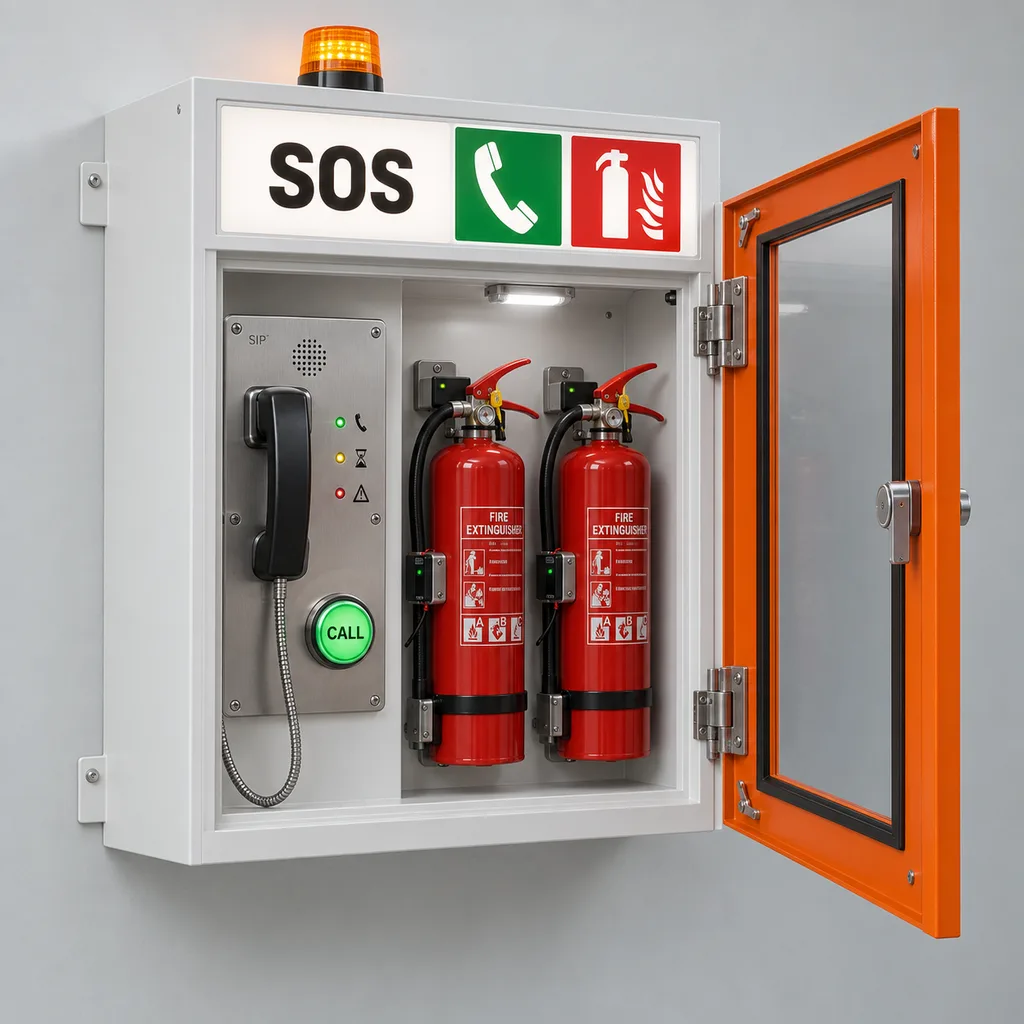
The REDCOAST.LTD RC-TES-600 is a mains-powered, network-connected emergency station for road tunnels, long urban underpasses and enclosed highway structures. It combines a noise-hardened SIP emergency telephone, supervised monitoring of fire extinguishers, station doors, manual call points and hydrant cabinets, illuminated SOS signage and a local LiFePO4 backup in one engineered unit that reports to the tunnel control centre in real time. Tunnel owners, operators and EPC contractors use it to meet emergency-station requirements such as Directive 2004/54/EC (stations near the portals and at intervals of no more than 150 m in new tunnels) and NFPA 502 (emergency telephones and extinguishers at no more than 90 m). At the same time, every station becomes a live sensor point. When a driver opens the door, lifts the handset or removes an extinguisher, the operator sees the exact tube and chainage at once and gets the matching camera view. That means faster incident checks, quicker tunnel closure when needed, and far fewer manual inspection rounds across hundreds of stations.
Key Features
- Noise-hardened SIP emergency telephone: An armoured handset plus hands-free mode, dual-microphone beamforming, adaptive noise suppression, acoustic echo cancellation, wideband G.722/Opus audio and up to 98 dB SPL speaker output keep calls clear near jet fans and heavy traffic.
- One-button, location-aware calling: A single illuminated CALL button dials the control centre and rolls over to up to three destinations if nobody answers. Station ID, tube, direction and chainage are sent with every call and alarm, so the operator never has to ask "where are you?".
- Extinguisher removal and return detection: Each bracket has a magnetic presence sensor. Optional load-cell weighing detects a partly discharged unit, and optional 13.56 MHz NFC tags confirm that the right, in-date extinguisher was put back.
- Supervised I/O for the whole niche: Sixteen inputs with end-of-line supervision cover the station door, manual call point, hydrant/hose-reel cabinet, cross-passage door and tamper switches. A cut or short-circuited wire is reported as a fault, so alarms are not silently lost.
- Automatic SCADA and CCTV response: Events go to the tunnel SCADA over Modbus TCP, IEC 60870-5-104, OPC UA or MQTT. The station can also call up an ONVIF camera preset, so the operator sees the station the moment its door opens.
- Illuminated SOS signage and flashing beacon: Internally lit SOS and ISO 7010 pictogram panels (emergency telephone, fire extinguisher, call point) have dimming that follows the tunnel lighting stages. An amber LED beacon flashes on door opening, a call or an alarm.
- Multilingual guidance and accessible design: Recorded voice instructions in up to four languages play when the door opens. Call-status pictogram LEDs (calling / connected / help dispatched) support users with hearing loss, and the handset is telecoil-compatible.
- Built-in resilience: A dual-fibre ring network that recovers in under 50 ms, plus a local LiFePO4 battery, keeps the phone, sensors and signs working through feeder faults, switchgear maintenance and generator changeover.
- Continuous self-diagnostics: The station runs a daily acoustic loop test of speaker and microphone, a weekly battery test, constant sensor-loop supervision and network health checks. Results appear on the REDCOAST.LTD web platform and the maintenance app.
Technical Architecture
The RC-TES-600 is built around three boards designed by REDCOAST.LTD for this product. The station controller PCB has an industrial ARM processor and a managed four-port Gigabit switch (two SFP fibre uplinks, two copper ports). It also carries 16 supervised inputs with end-of-line monitoring, 8 dry-contact relay outputs, an RS-485 port and an NFC reader bus for the extinguisher brackets. The SIP audio PCB handles the handset and hands-free audio. It includes a dual-MEMS microphone array with beamforming, noise suppression tuned to broadband tunnel noise, acoustic echo cancellation, a Class-D amplifier driving a weatherproof speaker, and storage for the multilingual voice prompts. The power management and LED driver PCB accepts AC 100-240 V or DC 36-72 V input. It charges and supervises the LiFePO4 backup pack through an integrated BMS and drives the sign panels, interior lamp and beacon with dimmable constant-current outputs.
Control logic runs locally, so the station behaves correctly even when the network is down. Opening the station door turns on the interior light, starts voice guidance and raises a "station occupied" event. Lifting the handset or pressing CALL places a SIP call to the control-centre console or IP-PBX. If nobody answers within a set time (typically 15-30 s), the call rolls over to a second and third destination. Operators can also open a listen-in call from the console. Removing an extinguisher, operating the manual call point or opening a hydrant cabinet raises a priority alarm and flashes the beacon. If the tunnel's control philosophy allows it, the station also sends the SCADA a pre-defined request for camera call-up, PA zone selection or traffic-management actions such as lane closure. The final traffic decision always stays with the operator or the SCADA logic. Every event is time-stamped (NTP or IEEE 1588 PTP), stored locally if the network is down and replayed when it returns, so the incident log stays complete for later investigation.
Edge and platform roles are kept separate. Safety-critical signalling (alarms, calls, SCADA tags) stays on the tunnel's private operational network and never depends on the public internet. The REDCOAST.LTD web platform, installed on-premise or in a private cloud, collects health and maintenance data: battery state, self-test results, sensor-loop faults, extinguisher service due dates, door cycles and call statistics. It shows them on a tunnel map by tube and chainage. With the companion mobile app, maintenance crews identify a station, read extinguisher NFC tags, close work orders and attach inspection photos, replacing paper-based rounds.
Connectivity & Power
Connectivity. The default backbone is a single-mode fibre ring. Each station has two 1000BASE-X SFP ports and runs ITU-T G.8032 ERPS, so a cut cable or failed station is bypassed in under 50 ms. This matters in tunnels, where one incident can damage a whole cable section. Copper Gigabit ports serve short underpass runs, a local camera (one PoE+ output, up to 30 W) or a cross-passage I/O node. Portal stations and isolated stations on tunnel approaches can add an LTE Cat-4 module as a backup path for alarms and management traffic. Where an old analogue emergency-telephone network has to stay in service during migration, an optional 2-wire gateway lets the stations run on the new SIP system while still working with the legacy exchange. Supported protocols include SIP (RFC 3261) with SRTP/TLS, Modbus TCP, IEC 60870-5-104, OPC UA, SNMP v2c/v3 and MQTT over TLS.
Power. The RC-TES-600 is a grid-powered product. It takes its supply from the tunnel's low-voltage distribution, which in a compliant tunnel is already backed by central UPS and/or emergency generators. Standard input is AC 100-240 V, 50/60 Hz, and a DC 36-72 V input is available for tunnels with a DC safety-power bus. Typical consumption is 12-18 W in standby with signs lit and about 45 W at peak during a call with the beacon and interior lighting on. A local LiFePO4 pack (12.8 V, 12/24/40 Ah) gives roughly 3, 6 or 10 hours of station-level autonomy at full peak load, and longer in standby. The phone and alarms therefore keep working through feeder faults and changeovers without relying only on the central UPS. The system uses no solar panels: tunnel stations sit inside an electrified structure where mains supply and protected cabling already exist. Integrated surge protection is standard. The portal variant adds an anti-condensation heater and a battery heater, because the BMS blocks charging below 0 °C.
Protection & Reliability
Tunnels are a harsh place for electronics, with diesel soot, NOx and SO2, de-icing salt spray at the portals, high-pressure tunnel washing, pressure pulses from passing heavy vehicles and jet-fan vibration. The RC-TES-600 enclosure is made from 316L stainless steel or marine-grade aluminium. It comes in a smooth polyester powder-coat finish, a brushed stainless finish, or a fluorocarbon coating for coastal portals. The electronics compartment is sealed to IP66 and the telephone front is vandal-resistant to IK10. PCBs are conformal-coated for condensing humidity, connectors are sealed, and the door latch and gasket are designed to stay closed under traffic pressure pulses. The operating range is −30 °C to +60 °C (heaters needed at the low end for portal installations), and the design targets salt-mist exposure testing to IEC 60068-2-52.
Fire behaviour is handled at system level. The housing and door are non-combustible metal and internal wiring is low-smoke, halogen-free (IEC 60754 / IEC 61034). We recommend that feeder and fibre cabling use fire-resistant types (IEC 60331 / EN 50200 class set by the tunnel designer), so stations outside the fire zone keep working while the fibre ring re-routes around the damaged section. As the EU directive itself notes, emergency stations are not meant to protect users from fire, and no station hardware is claimed to survive direct flame exposure. The network and power design is what keeps the remaining stations available. The enclosure design life is 20 years or more. Electronics are modular, front-replaceable units; the LED signs are rated above 50,000 h (L70), and the LiFePO4 pack is rated above 2,000 cycles. The standard warranty is 2 years and can be extended to 5 years under a service agreement.
Application Scenarios
- New motorway and expressway tunnels: Stations near each portal and at 150 m spacing or less inside each tube put a telephone and two extinguishers within a short walk of any vehicle. Every action is reported to the control centre, so the operator can verify an incident and decide on tunnel closure within seconds rather than minutes.
- Safety upgrades of existing tunnels: Older tunnels often have stations at 250 m or more, analogue phones and unmonitored extinguishers. Niche inserts can reuse the existing recesses and add monitoring, SIP calling and self-testing without major civil works, while extra stations close the spacing gaps.
- Long urban underpasses and covered roads: Underpasses beneath junctions, rail lines or waterfront parks get emergency stations linked to the city traffic management centre, with automatic camera call-up and lane-control requests. Urban operators get tunnel-grade safety without building a separate tunnel control room.
- Immersed-tube and subsea road tunnels: Long tunnels with no surface escape need dense, highly available stations. The fibre ring and station-level battery backup keep voice and alarm paths alive during the first critical minutes of an incident.
- Mountain-pass and cross-border tunnels: Heated portal stations with LTE backup handle severe winter conditions on remote approaches, and multilingual voice guidance helps international drivers who may not speak the local language.
- Bridges, galleries and enclosed highway structures: Long viaducts, avalanche galleries and noise-enclosure structures use the surface-mount version on walls or parapets, giving drivers a monitored help point where leaving the carriageway is difficult or dangerous.
Case-style Examples
Twin-tube motorway tunnel refurbishment. A 2.4 km twin-tube tunnel had emergency telephones every 250 m, analogue lines to an ageing exchange and extinguishers checked by hand each month. The owner needed 150 m spacing, monitored extinguishers and integration into a new SCADA system. The chosen configuration was RC-TES-600N niche inserts in the existing recesses plus new niches to close the gaps (about 36 stations across both tubes), a fibre ring per tube, Modbus TCP to the SCADA and ONVIF presets on the tunnel PTZ cameras. During site acceptance tests, lifting any extinguisher raised a located alarm in the control room and swung the nearest camera onto the station within a few seconds. Monthly paper rounds were replaced by app-based checks of self-test reports and extinguisher NFC tags.
New urban underpass on a ring road. A city built a 900 m twin-cell underpass beneath a busy interchange, operated from the municipal traffic management centre instead of a dedicated tunnel control room. The design used surface-mount RC-TES-600B stations every 150 m in each cell, copper and fibre links to the city network, OPC UA integration with the traffic management platform, and the accessibility pack (telecoil handset, call-status pictograms and voice prompts in four languages for a high share of visiting drivers). Calls and alarms now reach the same operators who run the city's signals and message signs, so they can respond to a breakdown or vehicle fire in the underpass with one coordinated workflow.
Mountain-pass tunnel portals and cross-passages. An operator of a 5 km tunnel on a high mountain pass saw repeated winter failures at portal emergency telephones and had no visibility of cross-passage doors. The upgrade used RC-TES-600P portal stations with battery and anti-condensation heaters, fluorocarbon-coated housings and LTE backup, plus I/O nodes on every cross-passage door and hydrant cabinet. The platform now shows door-left-open and heater-fault alerts before they become safety gaps, and winter self-test reports confirm that every portal phone works each day.
Customization & Selection Guide
- Pick the station format: Use the niche insert (RC-TES-600N) for new or existing recesses, with an acoustic-lined door that typically reduces traffic noise by about 15 dB(A). Use the surface-mount box (RC-TES-600B) where no recess exists, and the heated portal pedestal (RC-TES-600P) for outdoor approaches and toll-plaza areas.
- Size the quantity from the rule that applies: Typical drivers are Directive 2004/54/EC (portals plus no more than 150 m in new tunnels, 250 m in existing tunnels), NFPA 502 (no more than 90 m for telephones, call points and extinguishers) or the local tunnel code. Then add stations at portals, cross-passages and lay-bys as the safety design requires.
- Choose the network: A fibre ring is recommended for tunnels longer than roughly 500 m or any tunnel run from a SCADA control room. Copper Ethernet suits short underpasses. Add LTE backup for portals and isolated approach stations.
- Choose the extinguisher monitoring level: A magnetic presence switch covers the basic "removed / returned" alarm. Add a load cell where detecting a discharged extinguisher matters, and NFC identity tags where asset-compliance audits are required.
- Size the backup: A 12 Ah battery is enough where the tunnel's central UPS is robust. Choose 24 Ah or 40 Ah where the owner wants several hours of station-level autonomy independent of the central system.
- Choose the finish: Brushed 316L suits aggressive washing and pollution regimes. Powder coat in RAL 9003 signal white or RAL 2004 pure orange gives maximum visibility, and fluorocarbon coating suits coastal or high-UV portals.
- Match the budget tier: Essential is telephone, two extinguisher sensors and illuminated sign. Standard adds supervised I/O, fibre ring, self-test and the platform. Advanced adds NFC and load-cell extinguisher monitoring, an in-station camera, multilingual prompts and LTE backup.
Deployment & After-sales
Stations ship pre-wired and factory-tested. Niche inserts fix into the recess with stainless chemical anchors, and surface boxes mount on wall brackets. Cables enter from the bottom through sealed glands, and a configuration tool loads each station's ID, chainage and SIP/SCADA settings. Once cabling is in place, a two-person crew typically installs and commissions a station in one to two hours, which helps where tunnels can only be closed for short night-time windows. REDCOAST.LTD supplies the SCADA tag list and I/O mapping to the systems integrator, supports factory and site acceptance testing, and can commission remotely. Typical lead times are about 4-6 weeks for samples and 8-12 weeks for volume orders, depending on quantity and customization. After-sales support includes spare modules, firmware and security updates, operator and maintenance training, and remote diagnostics through the platform.
Standards & Compliance
- Designed to support emergency-station, emergency-power and equipment fire-resistance requirements in Directive 2004/54/EC Annex I, and the emergency telephone, fire alarm box and extinguisher provisions in NFPA 502
- Alarm-monitoring approach aligned with the PIARC Road Tunnels Manual (extinguisher removal and door-opening alarms to the control centre, CCTV call-up)
- CE marking direction: EMC Directive 2014/30/EU, Low Voltage Directive 2014/35/EU, RoHS 2011/65/EU
- IEC 60529 (IP66 electronics compartment), IEC 62262 (IK10 telephone front), IEC 60068-2 series environmental testing (cold, dry heat, damp heat, salt mist, vibration)
- Low-smoke halogen-free internal wiring to IEC 60754 / IEC 61034; recommended fire-resistant circuits to IEC 60331 / EN 50200
- ISO 7010 safety signs (E004 emergency telephone, F001 fire extinguisher, F005 fire alarm call point); manual call point interface compatible with EN 54-11 devices on the tunnel fire alarm system
- SIP RFC 3261, ITU-T G.722, ITU-T G.8032 ERPS, IEEE 1588 PTP, ONVIF Profile S/T; cybersecurity built along IEC 62443-4-2 principles
- Project-specific type testing and third-party certification can be arranged to suit the tender
Why REDCOAST.LTD
REDCOAST.LTD delivers tunnel emergency stations as one integrated solution: station hardware, SCADA and CCTV integration, the web management platform and the maintenance app, engineered and supported by one team. Because we design and develop our own hardware, including custom PCBs for station control, noise-hardened audio and power management, we can adapt the product to each project. Typical changes are extra supervised inputs for a specific cross-passage design, a different signage layout for a national tunnel code, a DC power bus, or a protocol your existing control centre already uses. You get a coherent system rather than a telephone, an I/O module and a sign from three suppliers. One team owns performance from the circuit board to the operator's screen, and your SCADA integrator, civil contractor and operator have one technical contact throughout the project.
Planning a new tunnel, an underpass or a safety retrofit? Send your tunnel length, number of tubes, required station spacing and control-centre protocols to REDCOAST.LTD, and we will propose an RC-TES-600 configuration and integration plan for your project.
Specifications
Emergency Communication
- Telephone Protocol
- SIP 2.0 (RFC 3261), SRTP/TLS
- Audio Codecs
- G.711 A/µ-law, G.722 wideband, Opus
- User Interface
- Armoured handset + hands-free, illuminated CALL button
- Hands-free Speaker Output
- up to 98 @ 1 m dB SPL
- Microphone Processing
- Dual-MEMS beamforming, noise suppression, AEC
- Usable Ambient Noise
- hands-free ≤85; handset ≤100 dB(A)
- Call Routing
- Up to 3 destinations, roll-over 10-60 s
- Voice Guidance
- Up to 4 languages, triggered on door opening
Station Monitoring & I/O
- Extinguisher Positions
- 2 standard (up to 4), up to 9 kg each
- Extinguisher Detection
- Magnetic presence switch; option load cell + 13.56 MHz NFC tag
- Supervised Digital Inputs
- 16 (EOL resistor, open/short fault detection)
- Relay Outputs
- 8 dry contacts, 1 A @ 30 V DC
- Serial Interface
- 1 × RS-485 (Modbus RTU)
- Event Latency to SCADA
- <500 (local network) ms
- Self-test
- Acoustic loop daily; battery weekly; loop supervision continuous
Signage & Lighting
- Sign Panels
- Internally lit SOS + ISO 7010 E004 / F001 / F005 pictograms
- Sign Luminance
- 100-300, 4-step dimming to tunnel lighting stage cd/m²
- Status Beacon
- Amber LED, 1 Hz flash on door/call/alarm
- Interior Lighting
- ≥200 at telephone panel (door open) lx
- Call-status Pictograms
- 3 (calling / connected / help dispatched)
- LED Lifetime
- >50,000 (L70) h
Network & Integration
- Fibre Uplinks
- 2 × 1000BASE-X SFP, single-mode up to 20 km
- Ring Redundancy
- ITU-T G.8032 ERPS, recovery <50 ms
- Copper Ports
- 2 × 10/100/1000BASE-T (1 × PoE+ 30 W)
- Cellular Backup (option)
- LTE Cat-4
- SCADA Protocols
- Modbus TCP, IEC 60870-5-104, OPC UA, SNMP v2c/v3, MQTT/TLS
- Video Integration
- ONVIF Profile S/T preset call-up
- Time Synchronisation
- NTP / IEEE 1588 PTP
Power (Grid)
- Input Voltage
- AC 100-240, 50/60 Hz (DC 36-72 V option) V
- Standby Consumption
- 12-18 W
- Peak Consumption
- 45 (call + beacon + lighting) W
- Heaters (portal variant)
- 60 anti-condensation + 20 battery heater W
- Local Backup Battery
- LiFePO4 12.8 V, 12 / 24 / 40 Ah
- Backup Autonomy at Peak Load
- ≈3 / 6 / 10 h
- Surge Protection
- Integrated SPD, Imax 10 kA (8/20 µs)
Mechanical & Environmental
- Enclosure Material
- 316L stainless steel 1.5-2.0 mm or marine-grade aluminium
- Surface Finish
- Polyester powder coat (RAL 9003 / RAL 2004 / custom), brushed stainless or fluorocarbon
- Ingress Protection
- IP66 electronics compartment, IP65 telephone front
- Impact Resistance
- IK10 (telephone front and buttons)
- Operating Temperature
- -30 to +60 (heaters required below -10 at portals) °C
- Humidity
- 5-100 condensing (conformal-coated PCBs) % RH
- Surface-box Dimensions (H×W×D)
- 1,200 × 800 × 350 typical mm
- Weight (without extinguishers)
- 55-75 kg
Capabilities — configurable per project
Specifications are tailored to each project — the options below show what we can support.
Station Format
- Niche insert with acoustic door (RC-TES-600N)
- Surface-mount box (RC-TES-600B)
- Heated portal pedestal (RC-TES-600P)
- Cross-passage / hydrant I/O node
Communication Backbone
- Single-mode fibre ring (ERPS)
- Copper Ethernet / PoE
- LTE backup for portals
- 2-wire gateway for legacy analogue networks
Extinguisher Monitoring
- Magnetic presence switch
- Load-cell weighing (discharge detection)
- NFC identity and service-date verification
Control-centre Integration
- Modbus TCP
- IEC 60870-5-104
- OPC UA
- SNMP / MQTT
Enclosure Finish
- Brushed 316L stainless steel
- Powder coat RAL 9003 signal white
- Powder coat RAL 2004 pure orange
- Fluorocarbon coating for coastal portals
Related solution guidance
Environmental Monitoring
Deploy environmental monitoring stations with sensors, solar power, gateways, dashboards, alarms and data integration for city and industrial sites.
Traffic Safety Checklist
Deployment checklist for connected traffic warning signs, beacons, road guidance devices, power, visibility, monitoring and acceptance tests.
Traffic Safety
Plan connected traffic safety systems with warning beacons, LED signs, road guidance devices, sensing, control cabinets and monitoring software.
Frequently Asked Questions
What equipment must a road tunnel emergency station include?
Under EU Directive 2004/54/EC, an emergency station must have at least an emergency telephone and two fire extinguishers, housed in a sidewall box or, preferably, a recess. NFPA 502 also calls for emergency telephones, manual fire alarm boxes and listed extinguisher cabinets along the roadway. The RC-TES-600 combines the telephone, two to four monitored extinguisher positions, a manual call point interface, illuminated SOS signage and a status beacon in one unit.
How far apart should emergency stations be placed in a tunnel?
Directive 2004/54/EC requires stations near the portals and inside the tunnel at intervals of no more than 150 m in new tunnels and 250 m in existing tunnels. NFPA 502 sets intervals of no more than 90 m (300 ft) for emergency telephones, manual fire alarm boxes and extinguishers, plus stations at cross-passages and exits. REDCOAST.LTD sizes the station count from whichever rule or national code applies to your project.
How does the control room know when someone removes a fire extinguisher?
Each extinguisher bracket has a magnetic presence sensor wired to a supervised input on the station controller. When an extinguisher is lifted, the station sends a located alarm (station ID, tube and chainage) to the SCADA within about half a second over Modbus TCP, IEC 60870-5-104, OPC UA or MQTT. It can also call up the nearest camera preset over ONVIF, the alarm-monitoring approach PIARC recommends.
Will an emergency phone work in a noisy tunnel with jet fans and heavy traffic?
Yes, within physical limits. The RC-TES-600 combines a dual-microphone beamforming array, adaptive noise suppression, echo cancellation and a speaker of up to 98 dB SPL. Hands-free mode stays intelligible up to about 85 dB(A) of ambient noise. Above that, the armoured noise-cancelling handset is used, and in niche installations the acoustic-lined door typically cuts traffic noise by about 15 dB(A).
What happens to the emergency stations during a power failure or a tunnel fire?
Stations are fed from the tunnel's UPS-backed safety supply. Each station also has its own LiFePO4 battery that gives roughly 3 to 10 hours at peak load, depending on the 12, 24 or 40 Ah pack chosen. The fibre ring re-routes traffic in under 50 ms if a cable section is damaged, so stations outside the fire zone stay online. Station hardware is not designed to survive direct flame, which matches the EU directive's position that emergency stations do not protect users from fire.
Can the RC-TES-600 integrate with our existing SCADA, CCTV and telephone exchange?
Yes. Calls use standard SIP (RFC 3261), so they work with IP-PBX systems and SIP operator consoles. Alarms and status are published over Modbus TCP, IEC 60870-5-104, OPC UA, SNMP or MQTT, and cameras are called up over ONVIF. For phased migrations, an optional 2-wire gateway keeps the stations compatible with a legacy analogue emergency-telephone exchange.
Can existing tunnel emergency niches be retrofitted without major civil works?
In most cases, yes. The RC-TES-600N niche insert is made to the dimensions of the existing recess, fixes with stainless chemical anchors and reuses the existing power and cable routes where they are serviceable. Once cabling is in place, a two-person crew typically installs and commissions a station in one to two hours, which fits short night-time closure windows.
What routine maintenance does the system need?
The station runs a daily acoustic loop test of speaker and microphone and a weekly battery test, and it supervises every sensor loop continuously, reporting any fault to the REDCOAST.LTD platform. Crews use the mobile app to read extinguisher NFC tags, check service due dates and close work orders, replacing most manual function checks. Physical tasks such as extinguisher servicing, gasket checks and cleaning follow the operator's normal tunnel maintenance schedule.